From COUM Transmissions to Throbbing Gristle, from Chris & Cosey to the present: how did the boundaries between body, representation, performance and sound disappear in Cosey Fanni Tutti’s practice?
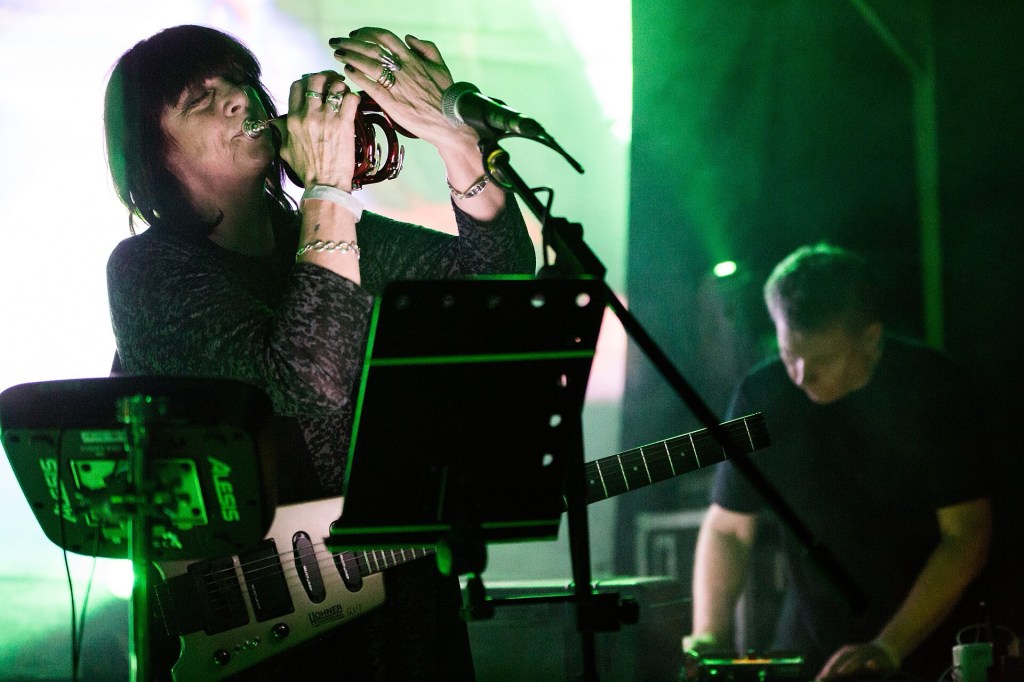
When does a body become a work of art? And when that same body appears as a commercial image on the pages of a magazine, as an art object in a gallery, and as an instrument producing sound on stage, which category can we place it in? Cosey Fanni Tutti’s practice, spanning more than fifty years, blurs precisely these boundaries. Performance art, pornographic imagery, photography, electronic music and personal experience are not separate fields in her work. On the contrary, one continually seeps into another.
Today, Cosey Fanni Tutti is often recognised as one of the pioneering figures of experimental music and industrial sound. Chris & Cosey, the duo she formed with Chris Carter, holds an important place in the history of electronic music; before that, both were members of Throbbing Gristle. Yet to read this story solely through music is to overlook one of the most significant aspects of Cosey’s practice. Because before sound, there was the body.
When the body becomes an artistic material
Emerging in Hull, England, in the early 1970s, COUM Transmissions was an experimental collective that rejected the boundaries of the traditional art object and worked primarily through performance. With Cosey Fanni Tutti at its centre, the group explored the body, sexuality, violence, social norms and the limits of what could be considered acceptable. Their work would later come to be regarded among the most controversial examples of British performance art. One of the most striking bodies of work Cosey developed during this period was Magazine Actions.
Between 1972 and 1980, Cosey worked as a model for pornographic magazines as part of this ongoing project. Yet she did not allow the resulting images to remain merely commercial photographs. By making the circulation of her own body across different contexts part of her artistic practice, she deliberately crossed the boundary between the sex industry and the art world. On her official website, she also describes Magazine Actions as an intervention into both the sex industry and the art industry.
What is particularly compelling here is that the artist’s body occupied several positions at once: Cosey was the person producing the image, the person within the image, and the person who later brought that image back into an art context.
The question facing the viewer, therefore, was not simply one of nudity or pornography. A more complex question emerged: Who determines the meaning of an image? The person who produces it?
The medium that publishes it? The person who looks at it? Or the context in which the image is displayed? When the same body that appears on the page of a pornographic magazine is moved onto a gallery wall, is it still the same image?
This is precisely one of the reasons Magazine Actions continues to be reconsidered within the histories of performance and conceptual art. Rather than simply representing the body, Cosey’s work entered directly into the systems through which representation itself was produced. Academic studies have also emphasised how Magazine Actions expanded the boundaries of performance and conceptual art while complicating easy classifications within feminist art history.
Prostitution : More than an exhibition
One of the most visible turning points in the history of this practice came in 1976 with the exhibition Prostitution at the Institute of Contemporary Arts (ICA) in London.
Bringing together works by COUM Transmissions, the exhibition also included images of Cosey that had appeared in pornographic magazines. Presented alongside performances, documents and other materials, the exhibition quickly moved beyond the boundaries of the art institution and became the subject of a national controversy.
The reaction from the press was severe. The exhibition was even discussed in Parliament. Conservative MP Nicholas Fairbairn attacked COUM Transmissions and the artists around them with the phrase that would later become permanently attached to their history: “wreckers of civilisation.” The phrase is used here as a direct historical quotation. For COUM, however, the media response did not remain something external to the exhibition. Newspaper reports and reviews about the show began to be added to the gallery itself. In this way, the scandal generated by the exhibition became part of the exhibition’s material. The way the media represented the artists became a living example of the very mechanisms of representation they had been investigating. For this reason, Prostitution cannot simply be read as a “shocking” exhibition. The deeper question concerned which images an art institution could accept, how the female body was evaluated in different contexts, and who had the authority to define an image as “art,” “pornography” or “obscenity.”
The fact that these questions remain relevant nearly half a century later also helps explain why the exhibition continues to be remembered as an important turning point in the history of British contemporary art.
When performance becomes noise
In the mid-1970s, another structure emerged from COUM Transmissions: Throbbing Gristle.
Formed by Cosey Fanni Tutti, Chris Carter, Genesis P-Orridge and Peter “Sleazy” Christopherson, the group transferred the confrontational and unsettling strategies of COUM’s performance practice into sound. Electronic devices, tape recordings, distorted sounds, repetition, noise and the rejection of conventional rock structures became central elements of their music.
Here, sound was not simply an aesthetic object created to be listened to. It produced an atmosphere, became a physical experience and, at times, deliberately unsettled the listener. For this reason, the history of Throbbing Gristle stands at the point where the history of music meets the history of performance art.
The group’s Industrial Records label and the language they developed played a decisive role in the formation of what would later become a much broader field known as “industrial music.” Today, the ICA also treats the practices of Throbbing Gristle and COUM as foundational references in the emergence of industrial music. In a sense, the exploration of boundaries that had taken place through the body during the COUM period was transferred into sound through Throbbing Gristle. The discomfort had not disappeared; it had simply changed form.
From noise to rhythm: Chris & Cosey
When the first period of Throbbing Gristle came to an end in 1981, Chris Carter and Cosey Fanni Tutti continued working together, and Chris & Cosey was born.
While their music retained the experimental electronic legacy of Throbbing Gristle, it also opened up another space. Synthesisers, electronic rhythms, sampling, Cosey’s vocals and different instruments began to appear within a more rhythmic and, at times, danceable structure. Yet this shift did not mean abandoning the experimental approach they had developed earlier.
Even during the 1980s, when electronic music was becoming increasingly entangled with popular culture, Chris & Cosey continued to explore the physical, repetitive and hypnotic qualities of sound. In the years that followed, Chris Carter and Cosey Fanni Tutti continued to work together under different projects and names, while the boundary between visual art and music in their practice never became entirely fixed. And perhaps this is where the most accurate way of understanding Cosey’s practice becomes visible.
Trying to define Cosey solely as a musician, a performance artist or the subject of a photograph is always inadequate. The power of her work lies precisely in the way these identities merge into one another. She places her own body inside a pornographic image. She brings that image back into the art world. She transforms performance into sound. She turns sound into a bodily experience. Rather than drawing a clear line between art and life, she works directly on that line.
The inclusion of Cosey Fanni Tutti’s work in WACK! Art and the Feminist Revolution, presented at MoMA PS1 in 2008, also demonstrates how her practice is now read not only within the history of experimental music, but within broader discussions of feminist art and performance history.
Fifty years later
2026 is a particularly significant year for this history. To mark the fiftieth anniversary of one of the key moments in the history of Throbbing Gristle, the Institute of Contemporary Arts is presenting a special programme titled TG50 on 18 October 2026. The date is not accidental: 18 October 1976 was the date of Throbbing Gristle’s performance at the ICA as part of the Prostitution exhibition.
The ICA programme includes films, talks and music. On the same day, Chris Carter and Cosey Fanni Tutti will also take part in a conversation with The Quietus editor Luke Turner, discussing the early years of Throbbing Gristle, the London of that period, and the forms of art and music they developed within the city’s cultural underground. Returning to the same institution fifty years later is not simply a nostalgic anniversary.
Many of the questions that caused scandal in 1976 remain with us today in different forms: Who owns the body? Who controls the circulation of an image? Where does the boundary between art and commercial imagery begin? How does an artist’s representation of their own body change through the viewer’s gaze? Where does art’s right to disturb end? Perhaps this is why Cosey Fanni Tutti’s practice still feels so contemporary. Because in her work, the body was never simply an object to be looked at. The body was a method.
An image. A performance. A sound. And sometimes, a noise.
Sources
Institute of Contemporary Arts (ICA) — ‘Prostitution’ Revisited, Melanie Coles, 2016.
https://archive.ica.art/bulletin/prostitution-revisited/
Institute of Contemporary Arts (ICA) — Throbbing Gristle: TG50, 2026.
https://ica.art/live/tg50
Cosey Fanni Tutti — Official Website — Magazine Actions.
https://coseyfannitutti.com/
Chris & Cosey / Carter Tutti — Official Website
https://www.chrisandcosey.com/content/biographies.html
Eleanor Roberts — Performance and Prostitution: The Magazine Actions of Cosey Fanni Tutti.
https://pure.roehampton.ac.uk/portal/en/publications/performance-and-prostitution-the-magazine-actions-of-cosey-fanni-/
Museum of Modern Art (MoMA) — Cosey Fanni Tutti artist page / WACK! Art and the Feminist Revolution.
https://www.moma.org/artists/136860-cosey-fanni-tutti


 ArtMeant* Project