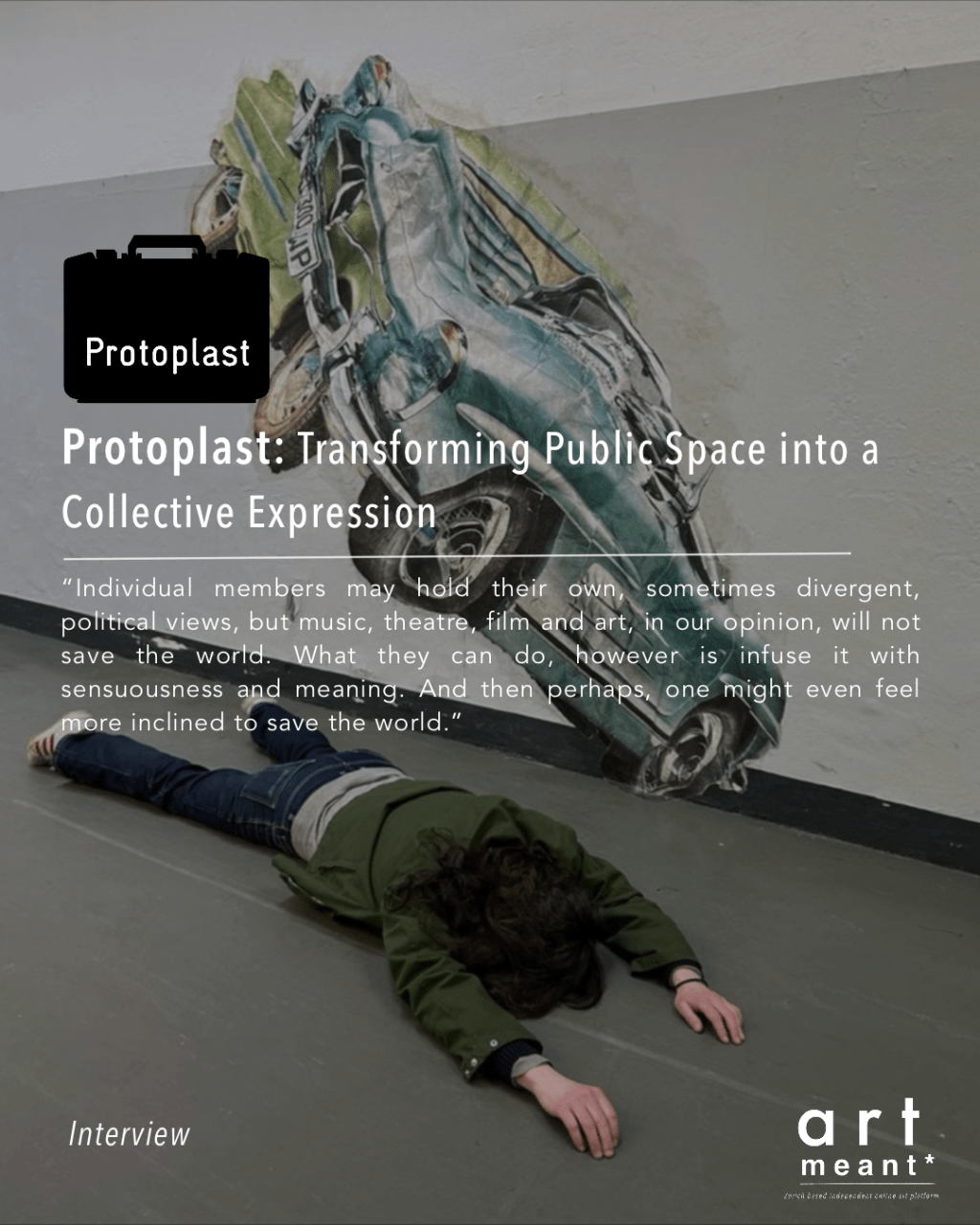
Founded in 1990, Protoplast is a long-term collaborative practice of four Swiss artists. Working together for more than 30 years, the group initially produced “imaginary products”; since 2011, they have continued their path with a new conceptual program called “artefact production.”
From Basel to Madrid, from Stuttgart to Montreux, Protoplast transforms public space into a gallery billboards, stations, walls, and city surfaces become their contemporary canvas.
We talked about the visibility of art in public space, the dynamics of collective production, and their evolving aesthetic approaches over time.
Interview:Buket Bal Soezeri

I know that you were founded in 1990. What was the main idea that brought you together during the foundation process? How was Protoplast created and with what motivation?
The term “Protoplast” captivated us from the very beginning – both in its biblical meaning as the primordial human and in its biological definition. In the biblical context, the Protoplast represents the original human being, a figure before the division into male and female, symbolising the unity of humankind. We wanted to give this layered concept a contemporary artistic reading and integrate it as a metaphor into our practice. When we came together in 1990, it was part of a broader exploration: questioning what a modern human endeavour could be. The early 1990s were marked by a sense of renewal and optimism the end of the Cold War, emerging technological possibilities, and a collective curiosity about the future. The idea of “social sculpture” as developed by Beuys was also a formative influence. And, not least, we were drawn to the clear, memorable sound of the name “Protoplast.”
If we ask you to describe Protoplast in a few sentences, what would you say?
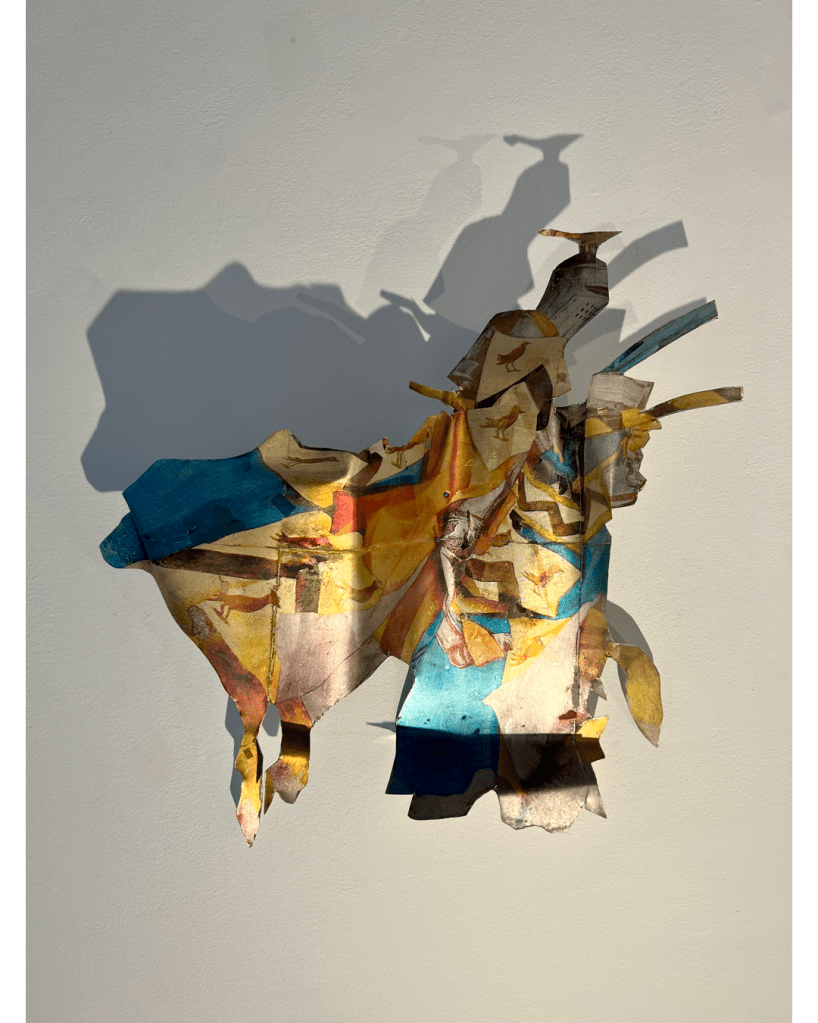
In one sentence as you’ll see in our Instagram bio “We are a gang of four who wake and ache.” We don’t provide interpretations of this phrase or our work, since we believe that words, texts, or essays are more likely to hinder than help. As individuals, we don’t seek to influence how people encounter our artefacts be it installations, drawings, oil paintings, woodcuts, sculptures, or other forms of expression. Curator Heinke Haberland once described our visual language as chewing gum cubism but we’ve always avoided labeling our art. Due to the complexity of our photographic processes, we can never fully predict the results; often, we’re as surprised as our audience! In essence, we’re on the same page with viewers. Some might recognize us in public by the black suitcase we always carry it serves as our group’s symbol.
Who are the artists who founded Protoplast? Do you keep your identities hidden on purpose, or did this anonymity appear naturally over time? What does this choice mean to you?
Our anonymity matters to us, but it isn’t central to the work unlike, for example, Banksy. We simply prefer not to draw attention away from the art itself and don’t wish to be in the foreground. There’s no focus on individual ego or ambition, which is why we avoid having our names mentioned. When we founded Protoplast in 1990, our intention was to pursue collective activities under a single identity, symbolized by our black suitcase.
How have the changes in the art world from the 1990s until today affected you? What is your approach to processes such as digitalization and the transformation of public space?
To be honest, we much prefer today’s art world to that of 1990, when everything depended on positive reviews in print newspapers. If your exhibition didn’t appear there, it virtually didn’t exist. With social media, we’re now in control of our own destiny and no longer reliant on art journalists.
As a group, we don’t share a unified perspective or philosophy on social or technological issues. Our concern is solely the production of artefacts. We ourselves do not use AI or Photoshop but instead use manual and photographic processes for our work. In truth, we’re not completely certain ourselves what artefacts are we’re often as surprised by them as the audience. Individual members may hold their own, sometimes divergent, political views, but music, theatre, film, and art, in our opinion, will not save the world. What they can do, however, is infuse it with sensuousness and meaning. And then perhaps, one might even feel more inclined to save the world.
What triggered the transition from the “imaginary products” period to the “artefact production” period? What does this conceptual transformation mean to you?
This shift in our approach around 2010 happened for several reasons. First, there was a change in our group’s composition, which brought in fresh ideas and perspectives. Second, we had explored the concept of imaginary products for two decades and felt that everything essential had been said. Thirdly, we were eager to begin something new and had discovered the emerging “protoplastic visual language” which truly captivated us! We were drawn to follow this direction simply because it felt exhilarating.
Exhibiting in public space means that the artwork can reach more people and gain a wider field of expression. Why are such exhibition spaces (streets, billboards, stations) important to you? Does this form of expression have a protest side?
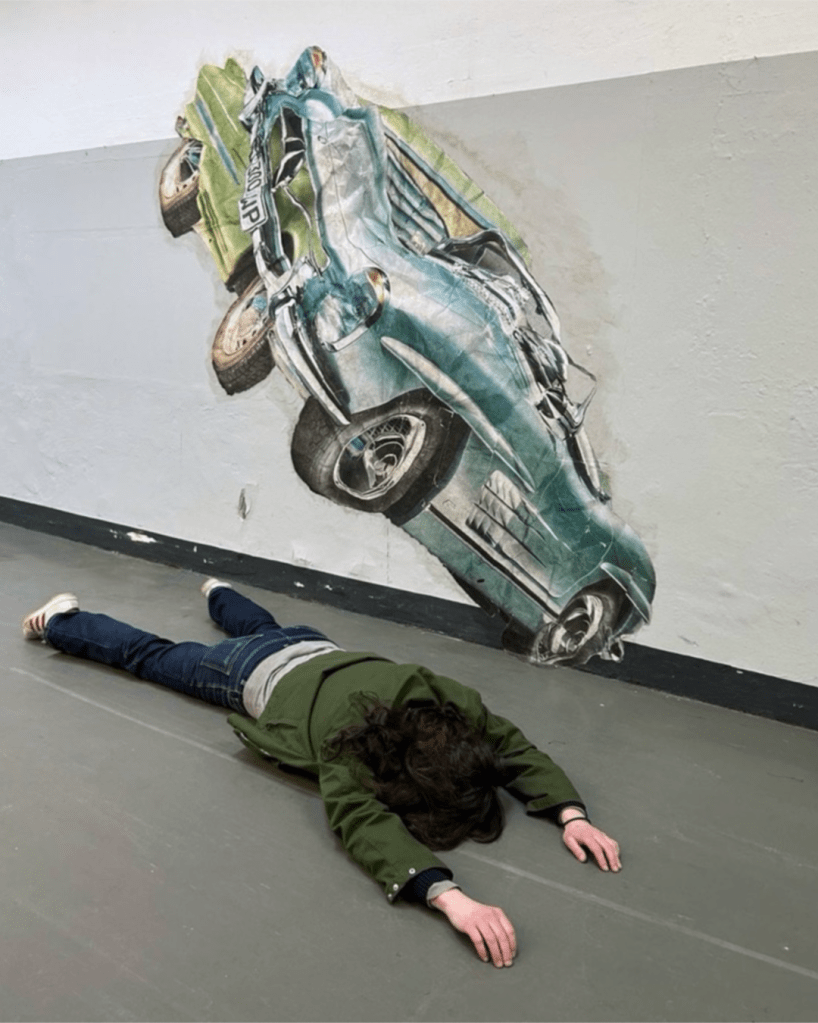
We actually began with street art specifically, wheat-paste posters. We worked on concrete surfaces at night, always keeping an eye out for the police. It was a matter of necessity: after years of quietly working in our studio, we had no other way of showing our art, as the art world had more or less forgotten us. So we turned necessity into a virtue and started to use this protest-inspired imagery as our artistic substrate essentially, the base material for our new artefact program. Before long, our Instagram account had grown to 75,000 followers. Incidentally, we remain utterly amazed by the tremendous interest from Asia.
How do you position posters as an art form?
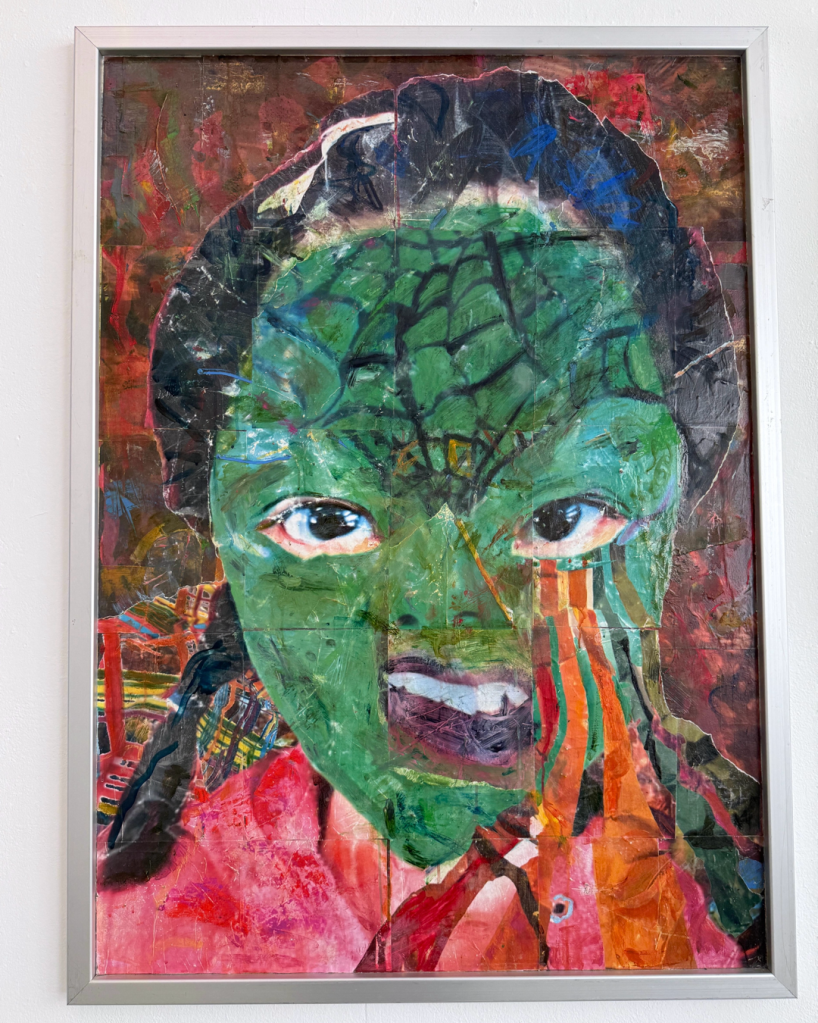
Over the years, we’ve found that art posters in public spaces can truly make a difference especially when the locations are carefully selected. In 2022, with the support of a distinguished patron, we launched our first series in Basel, placing 300 posters across the city. That debut series «angiognomic surrender», was bold and quite aggressive. The second series, «endobonempalaectomy», which we presented during Art Basel 2023, shifted the focus towards imagining novel forms of life emerging from civilization. In 2025, we continued to make our presence felt around the art fair with the «upcoming» series of posters. We thank the Galerie Sammlung Amann, Stuttgart, for their kind support.
What have you gained from exhibiting in different countries? What differences did you observe between audiences in cities like Basel, Düsseldorf and Madrid? Are there any projects you plan to realize outside of Europe?
Our experience exhibiting internationally has shown us how much context shapes reception. In Basel, for example, audiences engage with quiet focus and analytical curiosity. The advantage of Basel is that people are familiar with Protoplast. One disadvantage of one’s hometown is that people often assume something good cannot be so close by. Düsseldorf, on the other hand, brings a direct, energetic dialogue, reflecting its strong art traditions. Madrid’s response is warmer and more instinctive, with people connecting emotionally through their experiences. In February, we’ll present a new show at Die Box art space in Karlsruhe. In autumn 2026, we are scheduled to exhibit at FABRIKculture in France. Several additional projects are in development for Germany including solo exhibitions at Kaiserwache in Freiburg, DER MIXER gallery in Frankfurt, Galerie Jakob in Stuttgart, and a project in Lippstadt alongside an upcoming collaboration with a central art institution in Timișoara, Romania.
How does the production process work in a collective structure? From idea to realization, what does creating together mean for you? In short, how does the production process work in Protoplast?
First and foremost, our starting point for any exhibition is a close look at the particular situation and atmosphere of the space itself sometimes what works best is an intuitive fit, and other times, it’s more intriguing to introduce counterintuitive elements. This approach is always our foundation. Working as a team is genuinely rewarding; we’re good friends and have grown in sync over time, giving each other plenty of creative freedom. Often, we’re surprised ourselves by what comes out and what we’re able to enjoy together.
How do you bring together the idea of art and social criticism? How do you balance irony, criticism, and visual language in your works? What kind of contribution does the relationship between material and exhibition space make to the language of your works?
As a group, we neither aim nor feel compelled to voice political or social criticism through our art. We don’t see it as the essential role of artists to make political statements whether from the left, right or center. In our view, overt messaging often weakens artistic quality. Art, music, theater, and film are not instruments to save the world; real change comes from individuals acting as citizens environmentalists, politicians, volunteers, or humanitarian workers engaging in democracy and public discourse. We do this ourselves but choose not to discuss it publicly.
Our political views differ as much as anyone’s. Still, it’s not entirely excluded that future works might touch on social or ecological themes. In Stuttgart, for instance, we’ll address an environmental topic subtly and indirectly, never in a didactic way. Irony isn’t part of Protoplast’s toolbox or suitcase; we see humor as a vital ingredient instead.
What are Protoplast’s near-future plans? Could you tell us about new exhibitions, city projects, or collaborations?
The current group exhibition «To Be. Or To Have» at Fondation WhiteSpaceBlackBox in Neuchâtel runs until November 16, 2025. The next solo exhibition opens on November 21 at the new gallery Annahme Basel. In February 2026, a presentation will follow at Kunstraum Die Box in Karlsruhe. Another poster campaign is planned for June during Art Basel 2026.
For updates on exhibitions, projects, and news, visit our Instagram profile @protoplast.insta or our website at www.protoplast.ch/upcoming


 ArtMeant* Project
Yorum bırakın