In the artist’s practice, movement and transformation take precedence over permanence. Through masks, drawings, and digital collages, they explore the fragile boundaries of identity, memory, and embodiment. Rather than preservation, their approach embraces change capturing transient states of existence and suspended moments between presence and absence.
In this interview, we trace the roots of their practice: from early drawings as a survival mechanism, to a revelatory encounter with masks at École Jacques Lecoq in Paris, and later to the layered logic of digital collages. The artist reflects on vanishing identities, porous bodies, the role of memory, and the liberating power of disappearance.
Interview: Buket Bal Soezeri
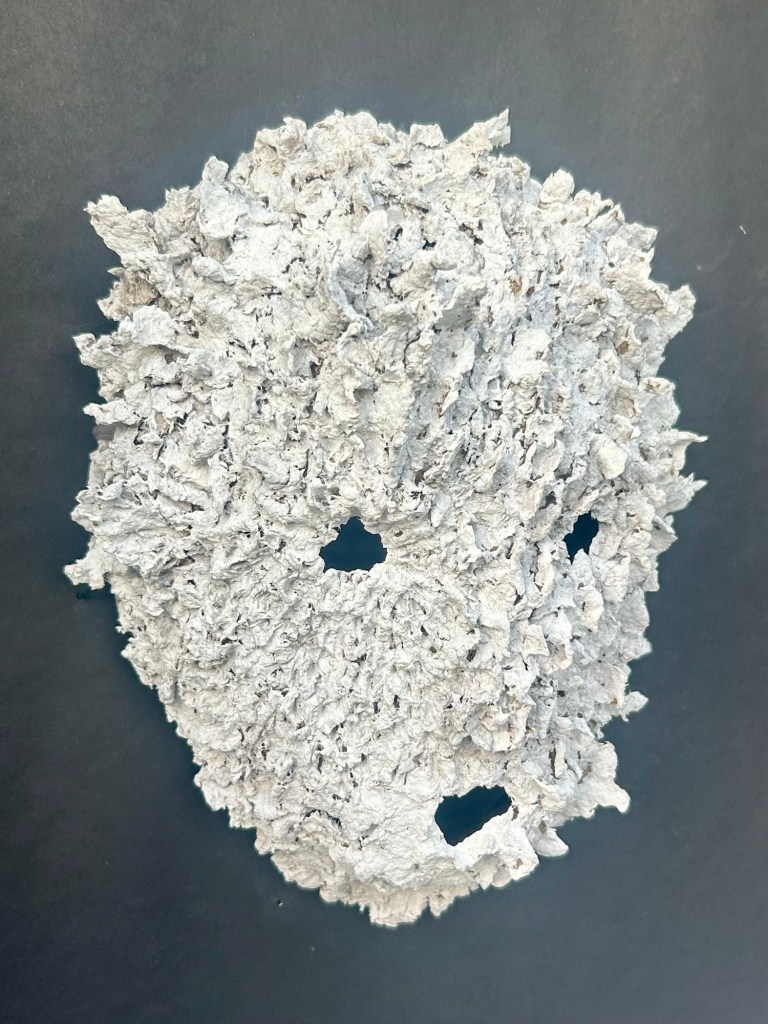
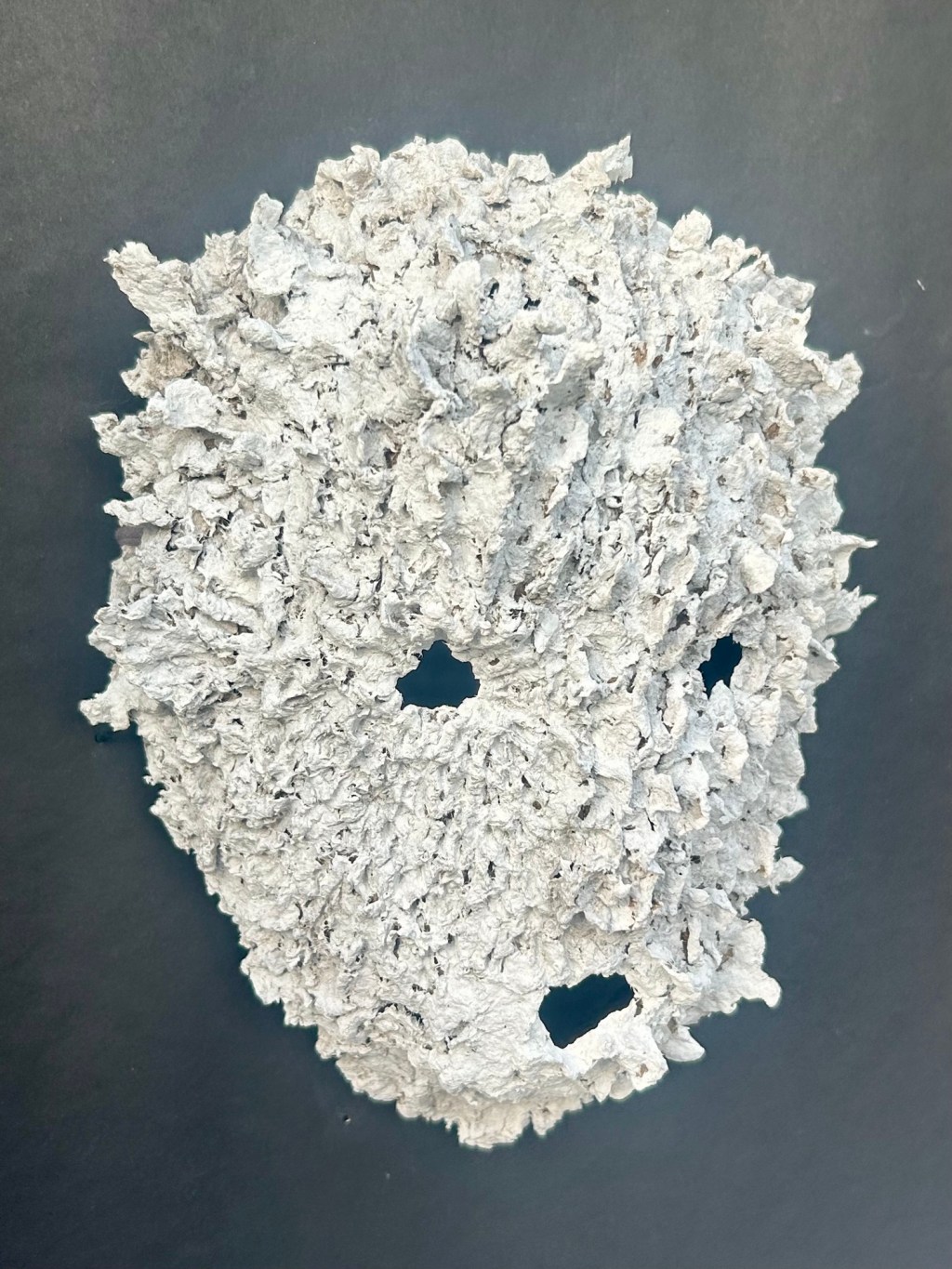
Vanishers, 2023 – 2024. papier mâché pulp&acrylic paint. 21.16,5.10cm, pictures by Carla Leroy
I would like to start with the roots of your art practice. What was the first moment that connected you with art? How did your journey grow from masks to drawings and digital collages?
Drawing was my survival mechanism before I understood it as art. I couldn’t focus in school my mind would scatter everywhere except the lesson so sketching became the only way to anchor myself to sitting still all day.
The real transformation happened at École Jacques Lecoq in Paris, where I encountered mask-making. Suddenly I understood something profound: covering the face didn’t hide expression it liberated the entire body to speak. When the face disappears, everything else comes alive. This paradox drew me deep into theater and the revelation that concealment can be the most honest form of communication.
Digital collages came much later, when I started working with my own photographs or collected images. I became fascinated by how memory actually operates never as neat, separate moments, but as layers bleeding into each other. In “Nuclear Family,” I took a classic family portrait and through successive layers made them disappear into each other, shrinking smaller and smaller until they became objects rather than people. It’s about how rigid social roles don’t preserve families they consume them.
All these different mediums help me to deepen my understanding of each of them, since to me they feel very connected.
The exhibition “Held in Passing” is not about permanence but about movement and change. In this context, you connect your works with “transformation” instead of “preservation.” What does this idea mean for you?
My “Vanishers” masks attempt something nearly impossible capturing states that exist only in transition. I’m obsessed with those liminal moments: the edge of sleep, intense joy or despair, how sometimes they feel identical, when your skin stops feeling like a boundary between your body and everything else.
While in meditation or love or even certain kinds of intoxication, identity becomes porous. The edges of “self” blur until there’s no clear separation between me and the world. It’s terrifying and liberating simultaneously.
My work consistently seeks things mid-transformation, perpetually becoming something else.
In the exhibition, your “Vanishers” works show fluid borders between identity, presence and absence through masks. What feelings or thoughts guided you while creating this series?
I realized I was making masks that do the opposite of what masks traditionally do. Instead of exaggerating features to amplify persona, I wanted them to dissolve identity entirely. When you hide the face, you escape the exhausting performance of being “yourself” all those social expectations fall away.
There’s incredible freedom in that dissolution. I notice how much more gets revealed when we stop focusing on faces and start seeing bodies, hands, the way someone holds themselves or moves through space. The face performs so much that it often obscures what’s actually happening underneath.
In your practice we see the temporary nature of identity, the fragility of the body and the fading of memory. How did your personal experiences shape these themes?
As a queer and trans person, I never really understood why so much of our identity had to be built around the preconceived frameworks of feminine and masculine. These categories don’t fit anyone perfectly, and I see people and friends suffer trying to squeeze themselves into these shapes.
Then there’s my genetics. I carry predispositions to breast and uterine cancer, which means I’ll likely undergo major surgeries removing organs that represent fertility and femininity in conventional terms. What surprised me was my reaction instead of devastation, I felt relief. These anticipated removals actually hold joy and freedom for me.
Living with this knowledge has taught me something specific about embodiment: our bodies are remarkable constructions that we inhabit only temporarily. We’re always just passing through. This isn’t philosophical it’s visceral, immediate knowledge that shapes how I move through the world and why the body appears so consistently in my work.
Traditionally masks are linked with theater and persona, but you rebuild them as signs of dissolution and fragility. How did the mask become an important tool of expression for you?
At Jacques Lecoq, I discovered that masks don’t just change how others see you they fundamentally alter how your body moves and breathes. There’s something about removing the face from the equation that makes everything else more honest.
I started paying attention to how much information we actually gather from bodies posture, gesture, the rhythm of someone’s walking. When we fixate on faces, we miss the profound communication happening everywhere else. The face has become such a performance site that it often blocks access to genuine vulnerability.
In other works, I do explore traditional mask-making creating archetypes for pieces inspired by Swiss folklore, our universal need to transform and disguise ourselves, how almost every culture develops carnival traditions that temporarily dissolve social hierarchies. But the “Vanishers” series goes further, asking what remains when even the possibility of persona falls away.
In the exhibition text and in your works, the idea of “suspended time” is important. How do time, disappearance and memory come together in your practice of collage, mask making and drawing?
I’m drawn to moments of change because they hold both mystery and promise. In my collages, I layer personal photographs so multiple temporalities coexist in single compositions. This mirrors how memory actually operates constantly rewriting itself, never linear. The present is never isolated but always intertwined with past experiences and imagined futures.
There’s something about recognizing our shared impermanence that creates connection rather than anxiety. Every stranger might disappear at any moment, and so might we. This knowledge makes me more present, more gentle with my own body, more curious about others.
After “Held in Passing”, what projects are you excited about? What are you working on now, or what do you plan for the future?
I’m developing “Here (but not entirely),” a research project exploring medical archives and historical anatomical illustrations. I’m fascinated by how these scientists’ genuine search for truth produced drawings that are devastatingly beautiful and sensitive. They force us to confront how much we still don’t know about bodies, how remarkable and mysterious they remain.
But these archives also reveal massive absences queer and trans perspectives are almost entirely missing from medical documentation. I want to bring my lived experience into dialogue with these historical materials, creating space for bodies like mine that medical history has largely erased.
I’m also directing “PoneyXPress,” a performance that reappropriates Western mythology. Since the Western genre is largely cinema-invented rather than historically accurate, we claim permission to completely rewrite it. We treat it like medieval knight tales stories that reveal truths about their times by creating new mythologies that serve contemporary needs.


 ArtMeant* Project
Yorum bırakın