Chiara Bertin’s practice grows out of archival research and living matter, moving through memory, history and transformation. Working with cyanotypes, algae and other fragile materials, she creates pieces that resist permanence and instead embrace change as part of their very form.
In the exhibition Held in Passing in Suhr, she explored this idea through works that could not be preserved in fixed states. By letting the materials shift over time, Bertin gave space to the forgotten voices of women whose legacies continue to resonate quietly, like seeds waiting to emerge.
Interview:Açelya Dursun
To begin, how did your journey with art start? Could you share how this passion developed into a professional path, shaped by your education and personal practice?
My journey started early thanks to my grandfather, who was an artist and designer. From the age of four, he would take me around Milan on his bike in the early morning to collect discarded materials like cardboard. He taught me to draw and to sculpt small objects, showing me that making is a process grounded in practice.
I don’t like to frame art as “passion”- being an artist is work. It’s a practice that requires formation, dedication, and time. Studying Contemporary Art at Ca’ Foscari in Venice, followed by a Master’s in Applied Arts in Florence and a Master’s in Art in the Public Sphere in Switzerland, gave me both theoretical tools and practical approaches. Over time, my research practice merged historical inquiry with artistic experimentation, allowing me to inhabit the space between memory, history, and creative expression.

Much of your work engages with overlooked stories of women botanists, scientists, and radical thinkers. What drew you to these figures, and how do they continue to inspire your practice?
Engaging with these stories allows me to build bridges between past and present. Their methods and practices continue to inform my work, offering models for how to enact knowledge, preserve memory, and create narratives that differ from the ones we commonly know. This accumulation of voices, methods, and histories forms a network keeps expanding that guides both my research and my artistic experimentation.
From Anna Atkins, I draw lines connecting to Aurelia Jotz, Carla Lonzi, Chiara Fumai, Mary Somerville, the mondine(Italian rice workers), Rosa Luxemburg, Fanny Hesse, Theresa Hak Kyung Cha, Joan of Arc, Thérèse de Lisieux, Francesca Cabrini, and others.
Your practice often combines archival research with reenactment. What role does this performative element play in reviving forgotten legacies?
Reenactment is central to my work because it transforms historical research into a lived experience. By practicing the techniques these women developed cyanotypes, fabric printing, agar cultures, I engage in a form of knowledge transmission. My work is not performance in the traditional sense, rather, I reenact precise gestures and working methods, inhabiting the practices themselves to let their legacies resonate.
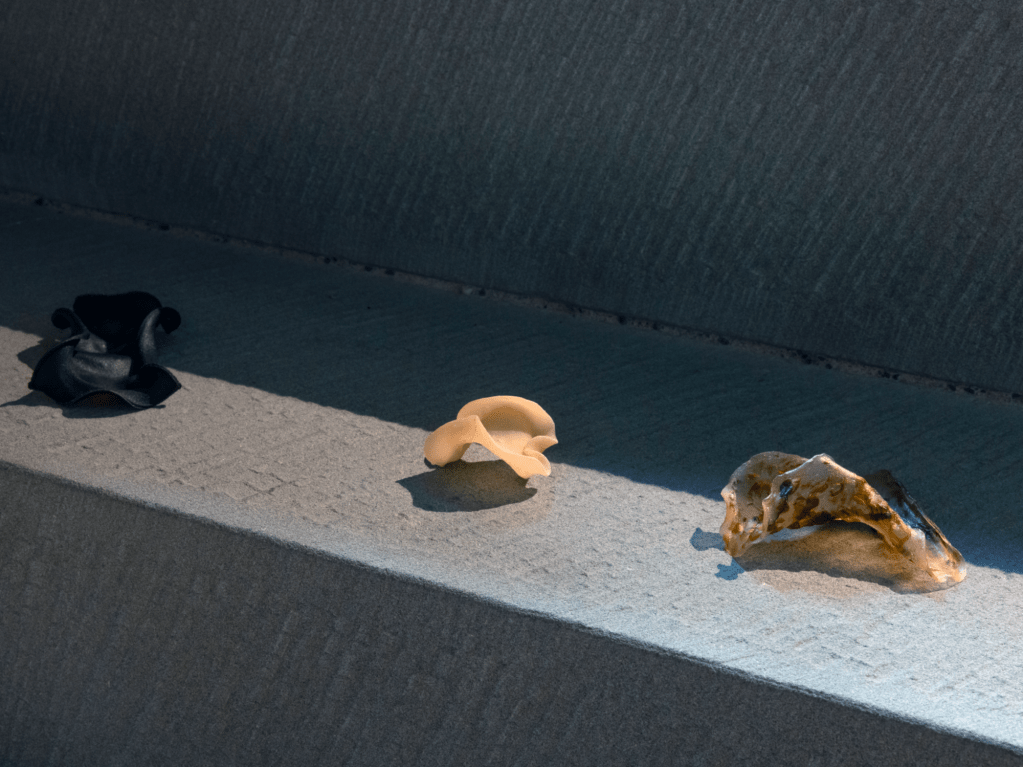
In Held in Passing, the exhibition explores organic forms growing through an urban shell. How did you approach this theme, and in what ways does your contribution respond to the idea of transformation within constraint?
In this exhibition, I explore biomaterials through foils and structures that challenge conventional ideas of preservation and transformation. I work with agar and carrageenan, two types of algae. Agar was introduced as a microbiology medium by Fanny Hesse, a largely overlooked scientist. It is ironic that Petri dishes small glass plates containing agar, used to isolate bacteria bear the name of their male inventor, while Hesse receives no recognition. They could have been called “Hesse’s medium,” or even “Petri & Hesse dishes,” since the content is as important as the container…
The exhibition also asks what it means to hold onto something as it changes. How does this question resonate with your work, especially in relation to plants, memory, and time?
The work reflects on temporality, resilience, and the beauty of things that evolve rather than remain fixed. Using display cases allows me to engage conceptually with the idea of conservation: in museums and scientific institutions, display cases are meant to preserve objects, to keep them unchanged indefinitely. Biomaterials, however, are alive and constantly in flux – they dry, mold, and sometimes develop in unexpected ways. By embracing the inherent variability of these materials, I question traditional notions of preservation and highlight the value of the ephemeral, where change, decay, and transformation are not losses but essential aspects of any life cycle.
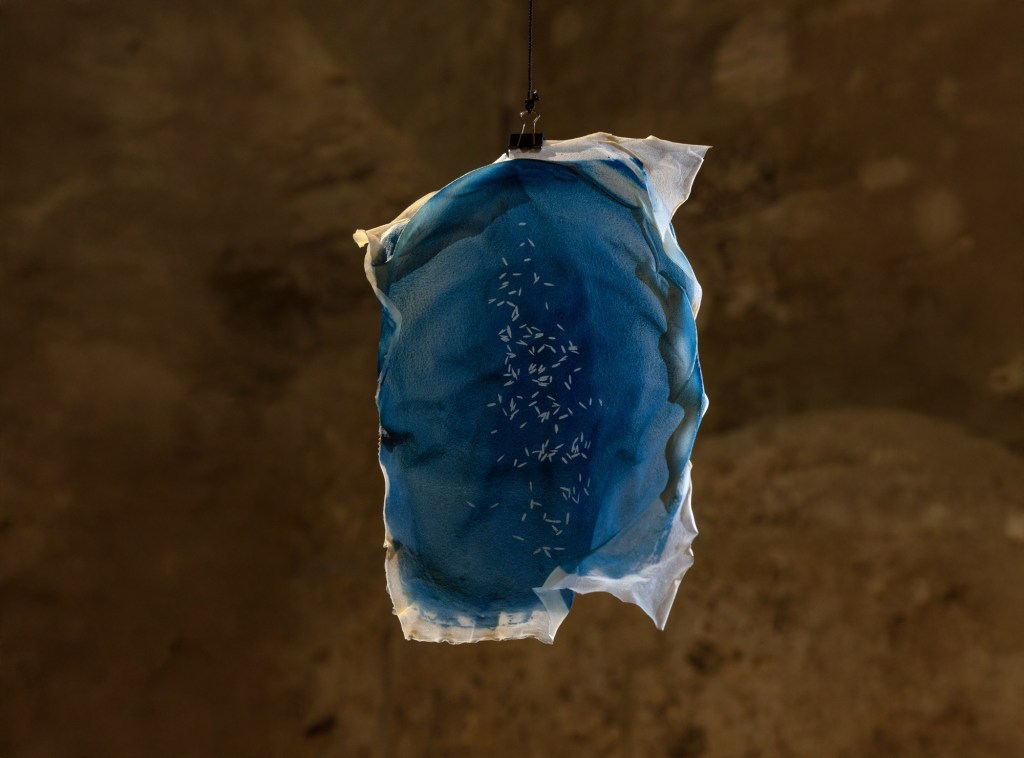
Your use of cyanotypes, fabric prints, and living materials like seeds and algae creates a dialogue between art and nature. What does working with such organic processes teach you as an artist?
These materials have their own rhythms and demands. The unpredictability of living elements creates a form of dialogue, challenges conventional art markets, and questions traditional ideas of permanence, as these works are destined to change and decompose over time. There is also an ecological dimension to my practice: I choose lightness and care in a world that is already overloaded and exploited.
Finally, what lies ahead for you after this exhibition? Are there upcoming new projects you’re excited to share?
I’m happy to share that one of my new pieces is currently exhibited in EYES WIDE SHUT with Matthias Amsler, Aleksandra Cegielska, Océane Jacob, Daniel Martinez, Gabriel Orlowski, and Vaste Programme. The exhibition runs from 23.08 to 20.09.2025 at Eleven Ten Studio, Burgweg 7,4058 Basel.
Cyanotype prints hang like shadows of memory, through headphones, the voices of Italian “Mondine” women fill the air, singing ballads of labor and resistance from the rice fields of the 1920s. The songs, almost lost to history, echo into the present, resonating with struggles that persist today: the fight for dignity, the refusal to be erased. The installation insists that forgetting is never neutral. What we no longer see, what history leaves in the margins, continues to live beneath the surface, like weeds that resist eradication.
(extract from the curatorial text by Alexandra Cegielska)
You can find more information here: EYES WIDE SHUT


 ArtMeant* Project
Yorum bırakın