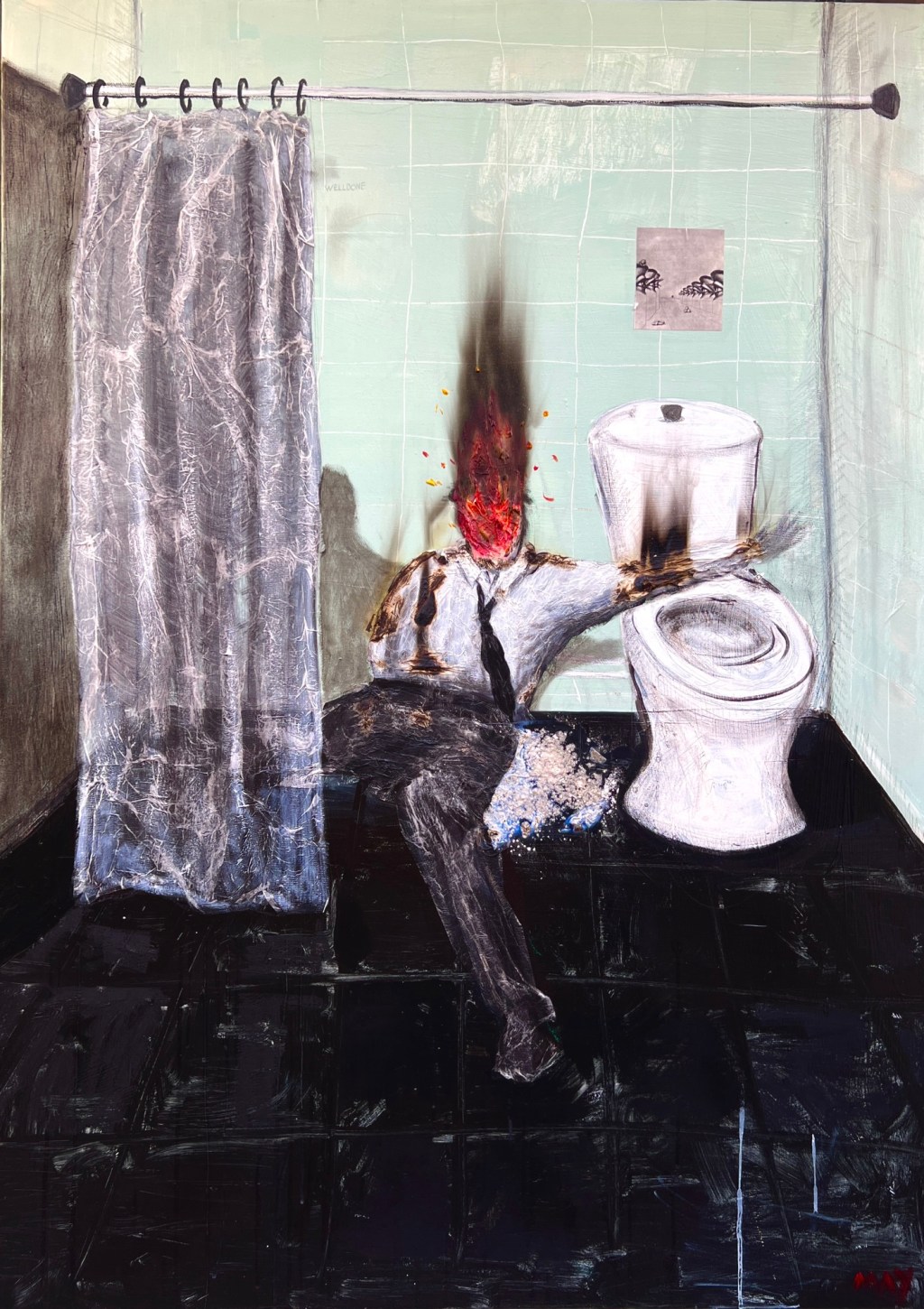
Author:Açelya Dursun
Mehmet Ali Yıldız’s artistic practice has long transcended the traditional act of painting. For him, painting resembles cooking: a physical and almost ritualistic engagement with the everyday. His works are not merely to be seen—they are to be sensed, experienced, inhabited. Thus, his canvases do not function as surfaces but as sites of confrontation. Often, they resemble crime scenes—inviting the viewer to read what is left behind, to sense absence, to feel violence and vulnerability simultaneously.
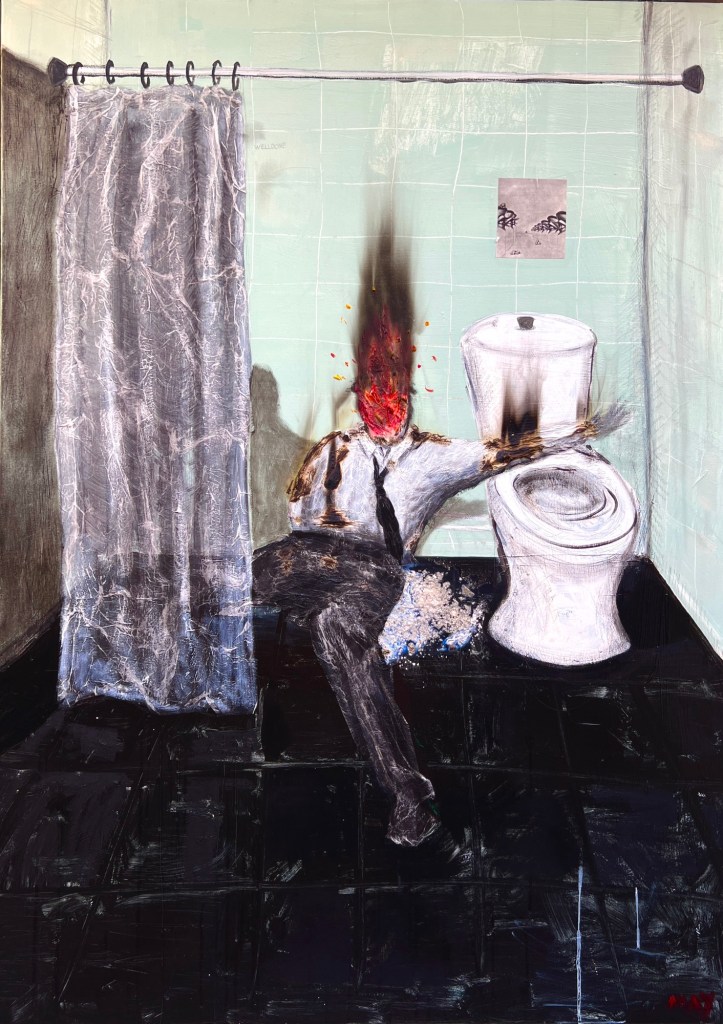
mixed media and fire on canvas, 2023
He incorporates materials from his own garden—not as ready-mades but as lived elements. His aim is not just to reproduce the visual, but to reclaim the personal, to materialize memory, and to construct a space of belonging. The materials he uses are not merely aesthetic tools; they are extensions of his relationship to place, family, and the natural world. To touch nature, as Tim Ingold suggests, is to come into contact with knowledge—a form of knowing shaped by the entanglement of body, space, and time.
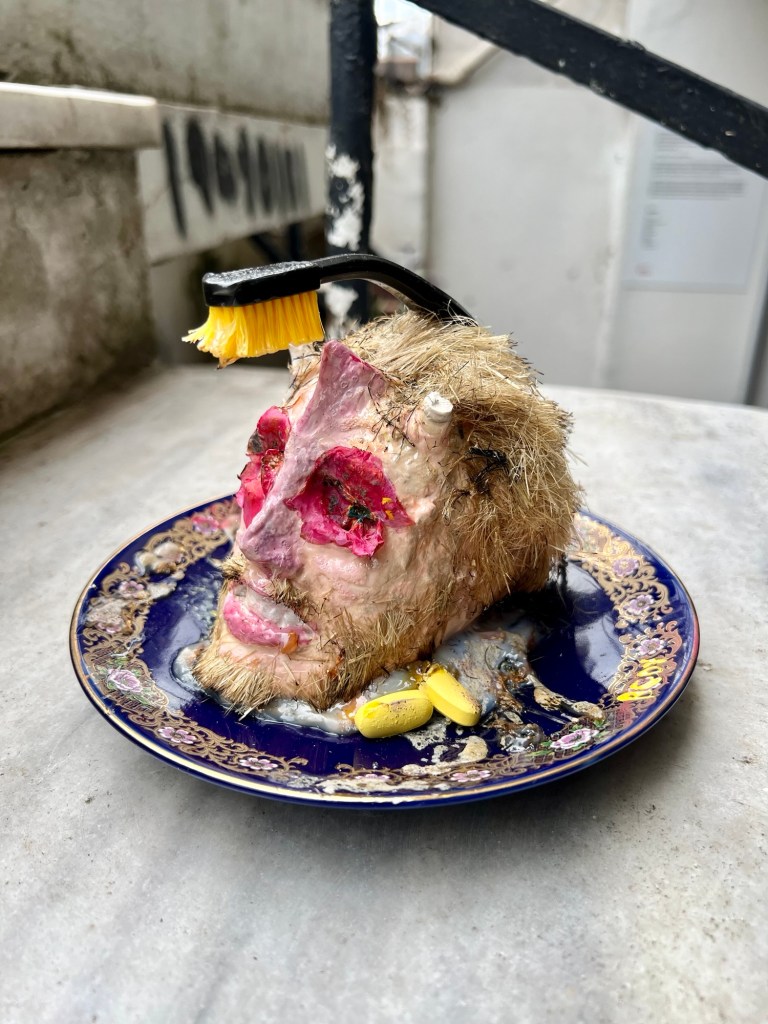
Mixed media sculpture, 2024, H 15 cm, Ø 18 cm
Sometimes, the material of his works is life itself. Pigment gives way to coffee, soil, or lime, turning the surface into something organic and animated. This vitality is not only biological, but ritualistic. Fire, in this context, is not a tool but a medium: it transforms, consumes, and inscribes. It leaves a mark—not just materially, but conceptually.
Yıldız’s compositions evoke a cinematographic sensibility. Rather than offering a fixed gaze, they circulate the viewer’s eye—provoking, redirecting, sometimes even assaulting it. The psychological intensity found in Francis Bacon’s distorted figures, or the bodily temporality explored by Marc Quinn, echoes in Yıldız’s work. In his practice, the gaze and the body are often in conflict—intimate, disquieting, and unresolved. The viewer is not passive; they are rendered an active witness. The narrative does not unfold linearly but emerges through suggestion, intuition, and layers.
This brings Giorgio Agamben’s concept of “bare life” into new focus. Yıldız’s work bears the marks not only of life but of lived experience—of the body, of struggle, of survival. Fire, as a chosen medium, becomes both destructive and generative: a force that erases yet imbues meaning.
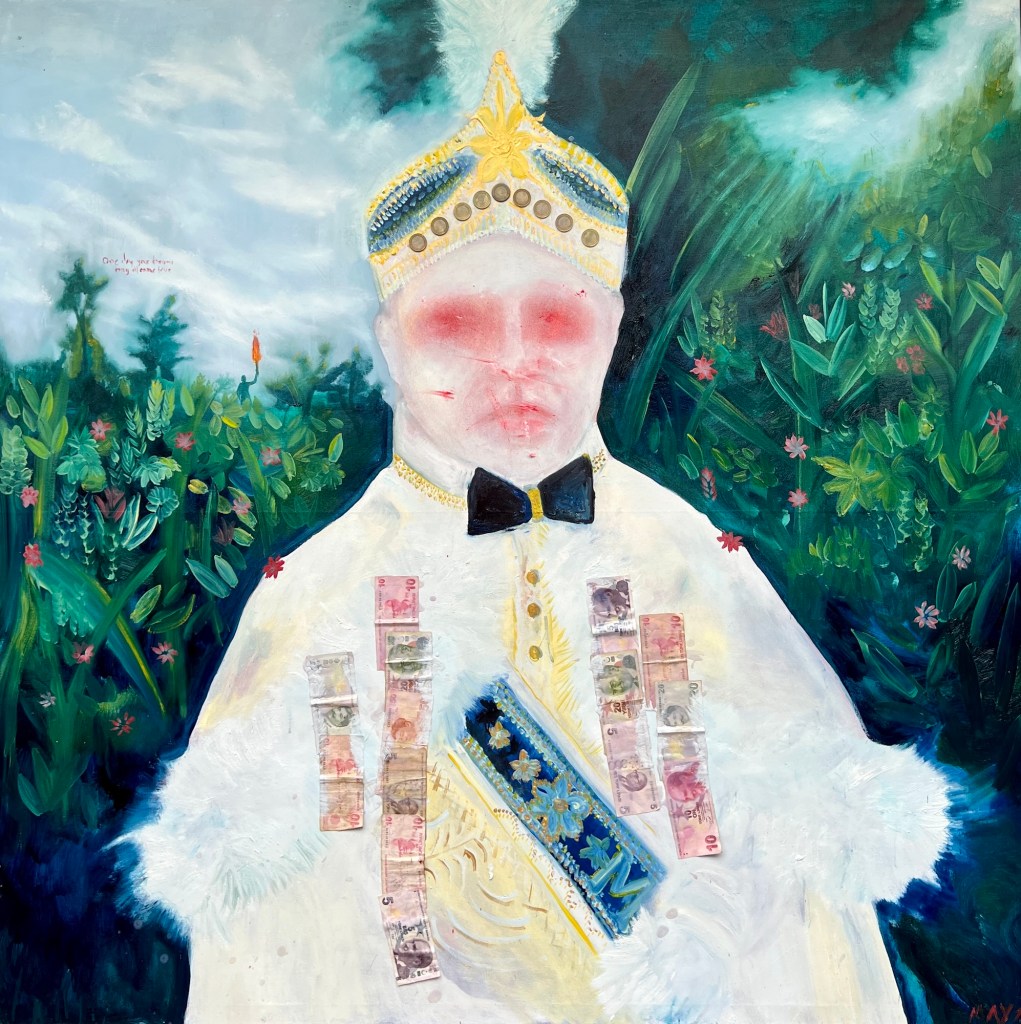
What may feel aggressive in his work also resonates with heroism. Some of his pieces verge on the monumental—not merely in scale, but in emotional and narrative intensity. There is a heroic gesture at play here, as Yıldız universalizes the personal, drawing the viewer into questions of their own belonging. Home, family, body, nature—all are fragmented and reassembled. Like cinematic montage, time is fractured, space is displaced, and the gaze is rebuilt.
Susan Sontag once defined art as “a means of creating sensory intensity.” Yıldız’s works carry this intensity in every layer—visual, tactile, intellectual. For him, art is not a site of purification, but of confrontation.
Ultimately, his practice may be read as a personal ritual—one grounded in place, body, and memory. It draws meaning from the everyday and offers the viewer an opportunity to reconstruct their own gaze. In this sense, the work of Mehmet Ali Yıldız is not only a formal experience, but an ethical and existential invitation.
References
Barthes, R.,Mythologies (A. Lavers, Trans.). New York: The Noonday Press, 1991.
Agamben, G. Kutsal İnsan, Egemen, İktidar ve Çıplak Hayat, (Çev. İsmail Türkmen), 4.Baskı, Ayrıntı Yayınları,İstanbul, 2020.
Campbell, Joseph. The Hero with a Thousand Faces. Bollingen Series 17, Princeton, Princeton University Press, 1973.
Ingold, Tim. Being Alive: Essays on Movement, Knowledge and Description. London: Routledge, 2011.
Bachelard, Gaston. Mekânın Poetikası. (Çev. Aykut Derman). İstanbul: Kesit Yayınları, 1996.
Sontag, Susan. On Photography. New York: Farrar, Straus and Giroux, 1977.


 ArtMeant* Project
Yorum bırakın