Author: Melis Dumlu
Franc Archive’s work doesn’t just question media, it exists inside it. Emerging from street art and evolving into immersive installations, his practice reflects a world oversaturated with information but starved for meaning. In a time when news is constant yet clarity is elusive, his installations echo the anxiety of living in the age of the spectacle.
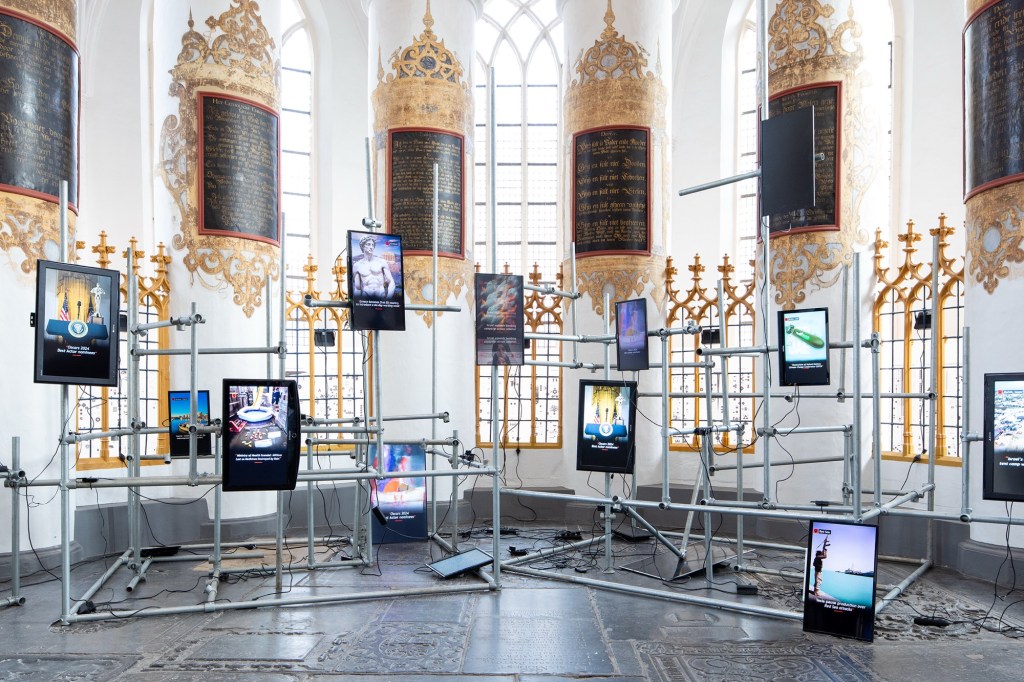
Flashing headlines. AI-generated videos. Glitching social feeds. In this work, Franc Archive builds a room where information becomes noise and truth dissolves into aesthetics. Referencing Guy Debord’s Society of the Spectacle, the piece shows how media doesn’t just report reality, it replaces it. What we live is not life, but its image.
This piece revisits a 1924 BBC broadcast, where a duet between a cellist and a nightingale captivated listeners. Decades later, the bird was revealed to be a human imitator. But at the time, it didn’t matter. The illusion was beautiful. Franc Archive connects this moment to our current media environment one defined not by truth, but by believability.

By mimicking the polished aesthetics of mainstream media, Franc Archive reveals how credibility often depends more on style than substance. His work draws from Jean Baudrillard’s concept of simulacra, asking not “Is this real?” but “Who decides what’s real?”
Franc Archive doesn’t offer answers. He offers space to question. In an era of deepfakes, algorithmic manipulation, and aestheticised misinformation, his art invites us to resist passive engagement. To not just consume media, but to confront it.
Because today, breaking news isn’t broken by journalists, it’s broken by us.
Bibliography
- Debord, Guy. The Society of the Spectacle. Translated by Donald Nicholson-Smith, Zone Books, 1994.
- Original French publication: La Société du Spectacle (1967).
- A critical theory classic exploring how media and representation have overtaken direct experience in capitalist societies.
- Baudrillard, Jean. Simulacra and Simulation. Translated by Sheila Faria Glaser, University of Michigan Press, 1994.
- Explores how representations (simulacra) replace reality in postmodern societies, leading to a collapse of meaning.
- Explores how representations (simulacra) replace reality in postmodern societies, leading to a collapse of meaning.
- Lightman, Alan. Einstein’s Dreams. Vintage, 1993.
- A fictional meditation on the nature of time, exploring multiple realities through dreamlike vignettes.
- A fictional meditation on the nature of time, exploring multiple realities through dreamlike vignettes.
- The BBC and the Nightingale Broadcast (Historical Note).
- Referenced in multiple retrospectives including:
- BBC Archive: “Beatrice Harrison and the Nightingale,” BBC Online.
- Mundy, Simon. Nightingale Nights: A Musician’s Reflections on Life and Love. (for poetic recounting).
- Referenced in multiple retrospectives including:
- Wardle, Claire and Derakhshan, Hossein. Information Disorder: Toward an Interdisciplinary Framework for Research and Policy Making. Council of Europe, 2017.
- Discusses disinformation, misinformation, and malinformation in digital media environments.
- Discusses disinformation, misinformation, and malinformation in digital media environments.
- Keen, Andrew. The Internet Is Not the Answer. Atlantic Monthly Press, 2015.
- A critique of digital culture and the effects of tech platforms on truth and power.
- A critique of digital culture and the effects of tech platforms on truth and power.



 ArtMeant* Project
Yorum bırakın