Zurich-based artist and designer Denisa Švachová is this week’s guest of the ArtMeant* Project.
Working across fashion, video art, and public space, Švachová creates a distinctive dialogue shaped by themes of sustainability and transformation.
She is currently preparing for a sustainable fashion show taking place on June 1st at Atelier Gemeinschaft Mithenquai, where she will also present and sell products created under her Seed Office label.
Švachová is also seeking new platforms to exhibit her video work Urban Echoes (2025), co-created with Denise Maud. The piece poetically traces Zurich’s unseen mechanisms of resilience, highlighting often-overlooked objects like emergency fountains and iodine tablets. After its debut at Material in Zurich, the work is now ready to be shown in broader contexts.
“The human scale is essential. I see costume as a form of body architecture, something that shapes and frames movement and perception. Through spatial installations, I try to encourage people to move, to become aware of their own presence and physicality.”
First, I want to ask how and where your interest in art started. Can you tell us how you turned this interest into a professional path through your education and personal practice?
My artistic journey started early, I’ve studied art since high school. I began at the Secondary School of Applied Arts in Uherské Hradiště, where I met people who continue to inspire and support me to this day. Some of my classmates later became my schoolmates again during my studies at the Academy of Fine Arts in Prague (AVU), where I first studied under Jiří Příhoda. His work, merging architecture and installation, had a strong impact on me.
During my time at AVU, I also did a two-semester exchange at UMPRUM (Academy of Arts, Architecture and Design in Prague) in the K.O.V. studio led by Eva Eisler. I recently reflected on this period as I visited an exhibition dedicated to her time as head of the studio (2007–2023). I also spent a semester abroad in Indonesia studying sculpture, though I mostly traveled during that time, the experience really opened my eyes. In fact, after returning, I questioned the meaning of making art at all and felt I might rather help people in more practical ways.
But when I came back to AVU after that exchange, we had new professors, Pavla Sceranková and Dušan Zahoranský, who brought a fresh approach. They helped me reconnect with what I truly loved about art and supported my interest in movement-based projects.
Later, studying MA Fine Arts in Zurich helped me a lot, mainly because I met a lot of people from the local art bubble, some of whom I am still in contact with.
In your art journey from Prague to Zurich, what was the most unforgettable project that shaped you the most?
One of the most unforgettable projects was Spirit Level (2018), my diploma work at AVU. I created a kind of “self-service performance” where the audience could follow instructions through headphones. The experience started with soft guidance through balance exercises, but gradually the instructions became more uncomfortable. I was exploring the boundaries and contrasting reactions to the same input, it was about perception, power dynamics, and embodiment.
Another deeply meaningful project was the scenography for the dance piece Treatment of Remembering (2020) by the collective PocketArt. The piece encourages viewers to look inward and awaken long-forgotten memories through physical and emotional experience connected with nature. I joined the team for multiple residencies and gave this project a lot of time, heart and tears and I believe it paid off. The piece received several awards, and thanks to its selection for Aerowaves Twenty22, it has been touring internationally and is still performed today. For example, on May 16, 2025, in CO.LABS Park in Brno in the Czech Republic.
But it’s hard to say, another very important project for me was Do You Mind If I Join You? about expats, in collaboration mainly with dancer Marketa Pščolková. You can check it out on Instagram @do_you_mind_if_i_join_you_
As I understand, your artistic work focuses on the body, costume, and staging.What do these elements mean to you? And why is it important for you to tell a story through the body and costume?
Yes, these three elements are really at the core of my work. For me, the human scale is essential. I see costume as a form of body architecture, something that shapes and frames movement and perception. Through spatial installations, I try to encourage people to move, to become aware of their own presence and physicality.
It’s also very important to me to bring together people from different backgrounds and explore themes collectively. I often let the process unfold quite organically, and I love seeing what form it eventually takes. Sometimes it becomes a film, sometimes a costume, or a performance.
In “Treatment of Remembering” and your other projects, you work with recycled or second-hand materials. What does this mean to you?
Working with recycled or second-hand materials, or simply with leftovers from past projects in my studio, feels very natural to me. I don’t like buying new things, I try to be responsible towards our planet and consider the environmental impact of my choices.
In the Treatment of Remembering, this approach was also part of the concept. The piece dealt with global ecological issues. At first, we imagined the scenography as a kind of landscape filled with waste. But we shifted towards a different visual language, a clean, sterile, white space, where the dancers recall their memories of nature.
For example, in A Lyric of Machines (2023), a performance by Katerina Sedy, I created a costume for which I used a second-hand work overall, old shoes from a Brocki, and I made a vest entirely from used cables.
When I need new materials, I often go to places like Offcut, second-hand shops, or material exchange rooms at institutions like ZHdK. Even in my personal life, I don’t buy many things, I get most of my furniture second-hand via platforms like Marketplace, Telegram groups, Tutti, or Ricardo. I rarely buy clothes and mostly just combine what I already have. I usually have one pair of favorite sneakers that I wear until they fall apart.
I would like to talk about your project Seed Office, which I follow with interest. How did the idea of Seed Office start? What kind of interaction or thinking process do you want to create with this project?
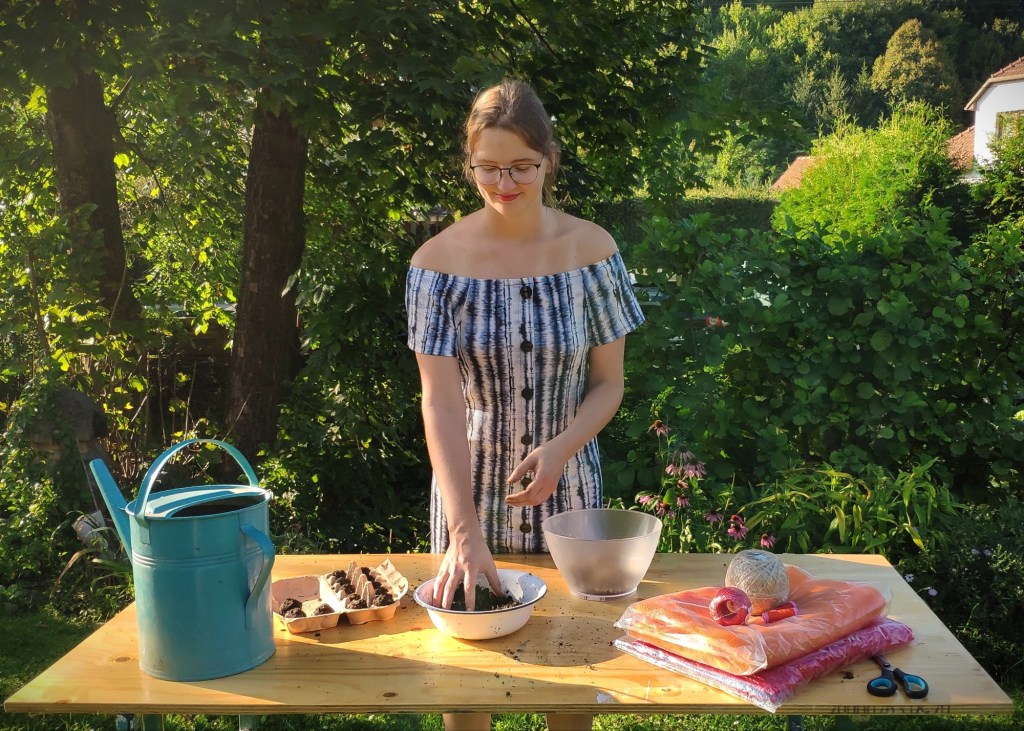
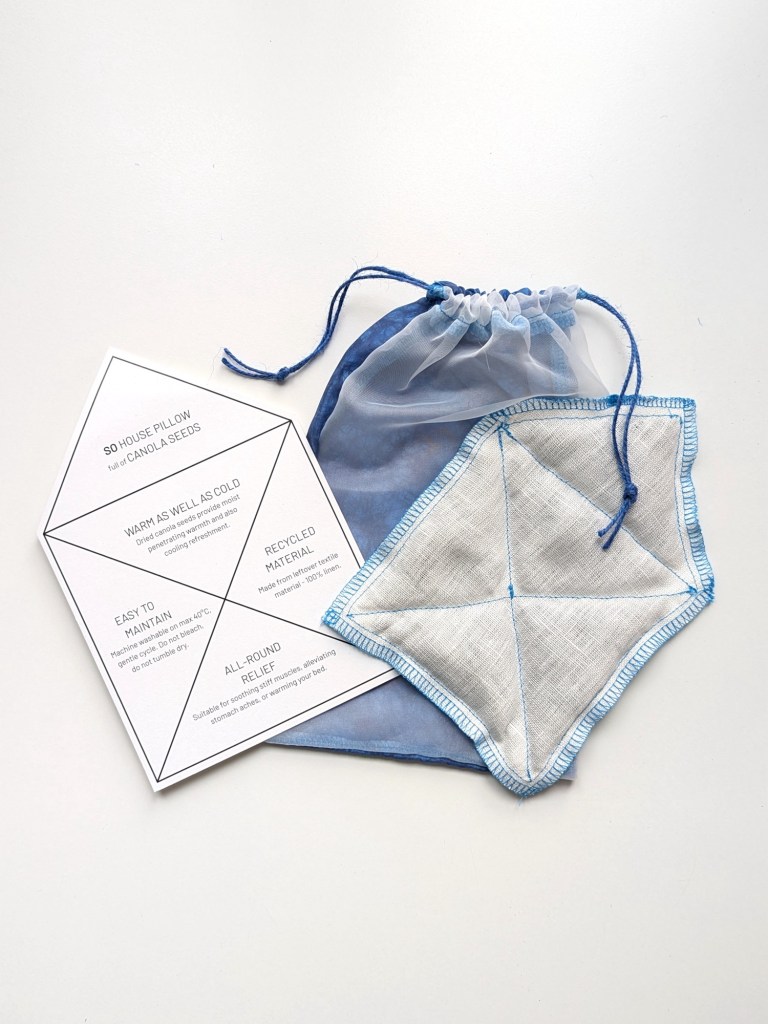
Seed Office began as a simple Instagram account where I shared the joy of sprouting seeds during COVID in a sprouting bowl from my brother. I started experimenting with sprouting as many different types of seeds and legumes as possible. Over time, the project grew into something more. I began designing and producing seed-related products with a focus on upcycling and also started organizing hands-on workshops.

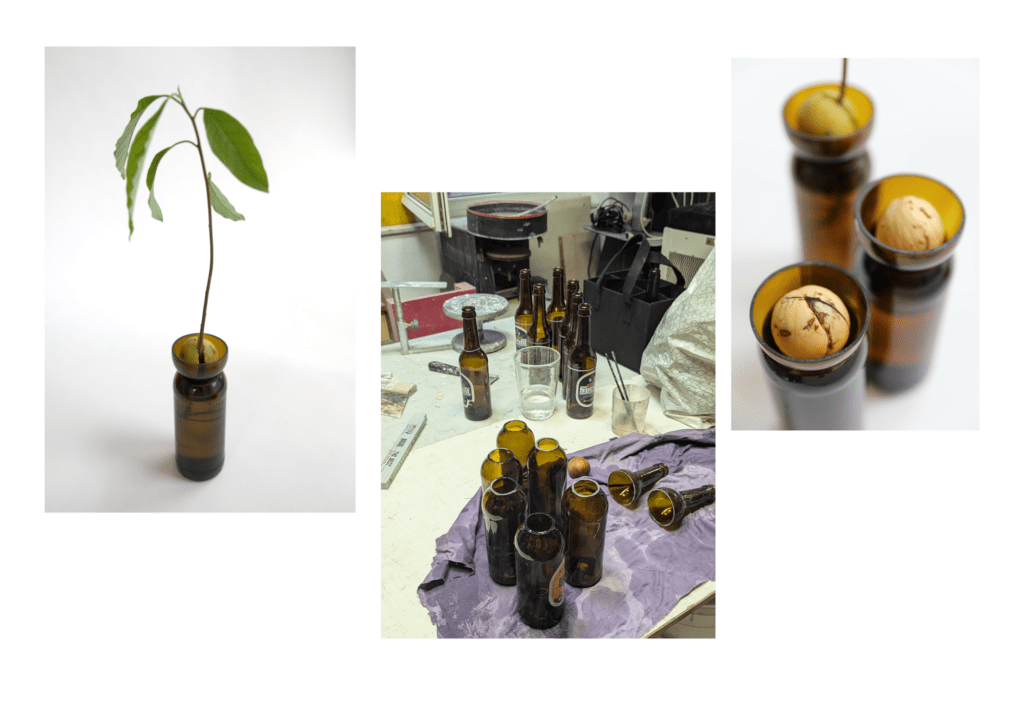
I’ve received great support from Tania Schellenberg, the founder of Faircustomer, who has invited me to many events as a guest or workshop host. This year, she invited me to participate in the Circular Exhibit at the Climate Hub Davos during WEF 2025.
How do you think your relationship with nature affects your art? Also, what does your current collaboration with Criptonite bring to you?
Nature influences my work on many levels, both conceptually and practically. I try to treat materials with care and responsibility. Observing nature also helps me reflect on time and cycles, themes that are often present in my projects.
Working with Criptonite has been truly enriching. It’s inspiring to be part of a team that constantly rethinks how performances can be accessible, not only physically but also emotionally and sensorially.
Nicole Frei invited me to participate as a costume assistant in Bioluminescence, a new performance by Criptonite premiering on July 1st at Tanzhaus Zürich. All costumes are made using only second-hand and leftover materials, which is a real luxury, because it takes so much time, energy, and care. Creating this way makes deep sense to me, and I’m very grateful we have the space to work like this.
You mentioned the idea of adding elements like Braille, sound, and touch to costumes. This idea is very exciting! Can you tell us more about this process? If there were creative challenges, what were they?
Yes, since Bioluminescence is designed as an accessibility performance, we’re developing costumes that are more sensorial. For example, each costume will have a distinct sound to help indicate the performer’s movement and position.
Criptonite invited sound/foley artist Marquis McGee to join the process. He introduced us to his fascinating collection of “toys” that produce specific sound effects. Some of these tools will be integrated directly into the costumes. But I don’t want to give too much away, come to the premiere! 😉
In your opinion, how does costume design offer a space to talk about social issues today?
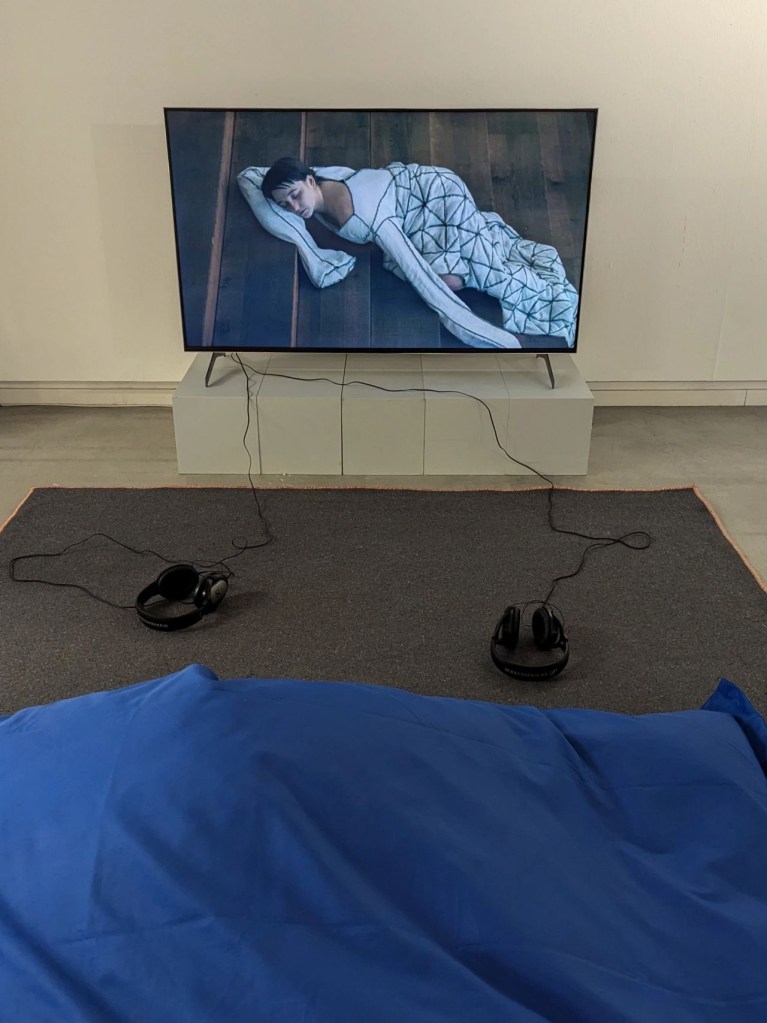
I think costume design can communicate things that are hard to put into words, especially when it comes to personal or social issues. One example for me was the project Let’s Talk About Tiredness (2024) made in collab with Anastasiia Tatarenko and Roni Idrizaj, which explored Chronic Fatigue Syndrome. I made a costume and a weighted blanket made from upcycled linen and filled with several kilos of flaxseed, made of 600 small hand-sewn triangles.
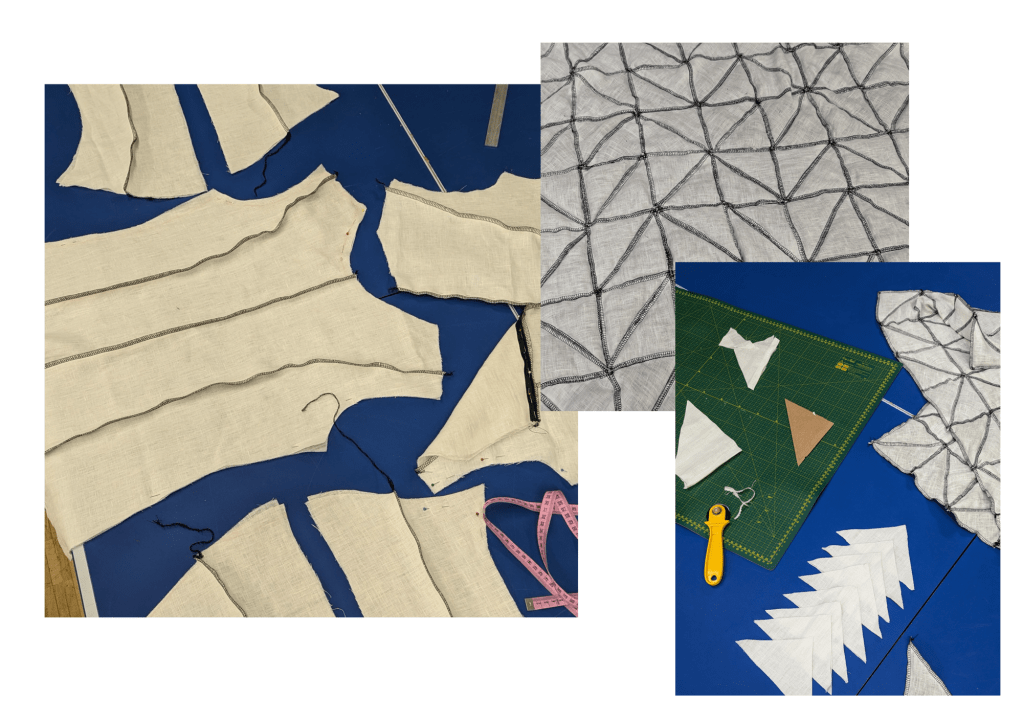
Through weight, texture, and movement, the costume helped express what it feels like to carry that kind of invisible exhaustion. I believe costume can create empathy and open conversations — not just through how it looks, but how it feels and what it makes people sense.

In the future, in which ways would you like to improve or expand your art practice? Do you have any new projects coming soon?
I’d love to continue working on costume design and keep developing my artistic practice through short films. With Seed Office, I want to keep offering workshops, and hopefully, in the future, find a space where I can run them more regularly.
At the moment, I’m preparing for a sustainable fashion show that will take place on June 1st at Atelier Gemeinschaft Mithenquai in Zurich. I will be presenting my upcycling costumes and then selling some of my Seed Office products. Everyone’s welcome!
I’d also like to show Urban Echoes (2025), a video I created with Denise Maud, in more exhibitions or festivals. The work traces Zurich’s unseen mechanisms of resilience, turning overlooked objects like emergency fountains and iodine tablets into poetic images. We first showed the piece at Material in Zurich, but we are now looking for new opportunities to present it in a broader context.


 ArtMeant* Project
Yorum bırakın