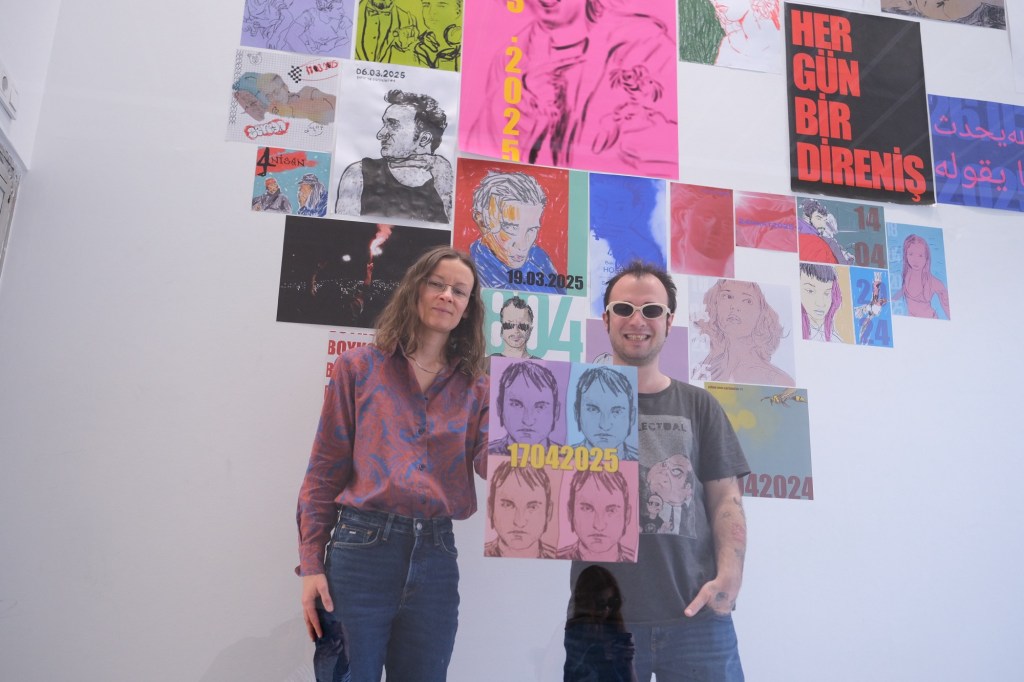
“Berkay Kahvecioğlu embraces a mode of production that draws inspiration from the street and offers it back to the street. Instead of using conventional materials and methods, he incorporates objects that carry the spirit of the space into his work, transforming them through intervention. In Kahvecioğlu’s hands, a garbage bag may become a sculpture, a paper collection cart may turn into a canvas, or falling snow may be transformed into an installation.”
Excerpt from the exhibition text of “A Poster for Every Day”
I’d like to start by talking about how your interest in art began. How do you evaluate the process of pursuing this interest professionally, within the context of your education and your own practice?
First of all, I accepted that I was an artist quite late, because being valued as an artist in this country is very difficult. But now, I want to be valued; otherwise, I was an artist from the very beginning I just recently admitted it. I studied animation for a year and sculpture for nine years. Love to all the instructors who contributed to my journey, and blessings to those who hindered me or tried to block my path.
The image your work creates for me is that the streets are often both your studio and the exhibition space for many of your pieces. What does this duality mean to you? Are there aspects of it that make things easier or more difficult for you?
I’m not just on the street I’m everywhere. I also work with galleries and institutions; we need everyone and everything. As long as we’re together, nothing is difficult for me. It’s either all of us together, or none of us.
Sending my love and respect to Ms. Melis Golar; she reminded me of the beauty of creating together again last summer.
As an artist who draws inspiration from the street, how important is it for you to experience the places you choose to work in? What connections or variables influence your choice of location?
I don’t draw inspiration only from the street in fact, maybe that’s where I draw the least from. I find inspiration everywhere from a bird in the sky to a stone on the ground; from every single particle.
You wander through the city’s labyrinths, observing, and through this exploration, you share your discoveries with us in a sincere and unifying language, often reminding us of things we’ve forgotten. From your current perspective, what does being an artist mean to you in terms of what and how you want to communicate?
My language is always sincere and unifying. My art is, by nature, quite disciplined, strict, and rule-bound but of course, it’s not military. I chose not to go to a military school at a very young age, even though I passed the entrance exam. Still, I consider myself a soldier of art.
Let’s talk about your ongoing exhibition project “A Poster for Every Day,” which suits your practice perfectly and which we follow with great interest. How did this exhibition idea come about?
This idea has always existed; it used to be more like “I have a poster for certain days!”
The venue has changed it’s no longer on the street, but in a gallery window now.

Do you work on your posters at the same time every day? If someone wants to see you in action, when and where should they go?
They can message me and come by. I don’t have a fixed time; generally, I meet with Civan Atik between 2:00–4:00 PM. He takes my photos bless him. There’s also a place I go to regularly: Araftafaray. I can eat there, thankfully.
Thank you, dear!
The posters you produce throughout the exhibition are created to reflect the spirit and presence of each day. Do you prepare in advance, or are these pieces mostly spontaneous, shaped by the moment?
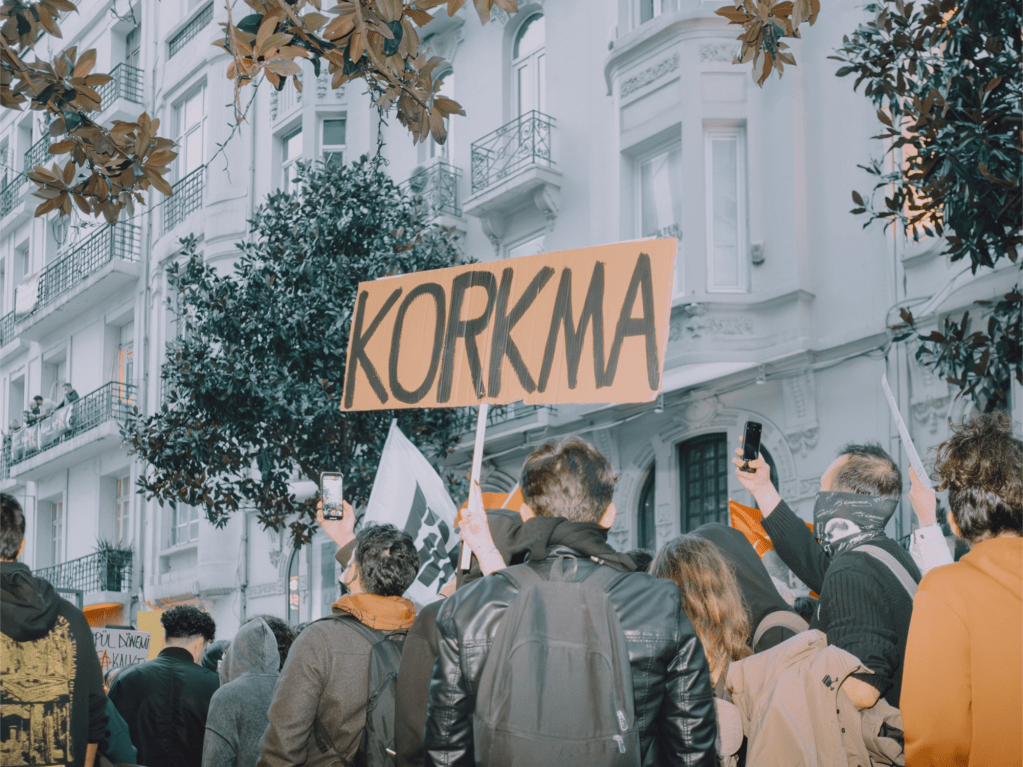
Of course, I do some preparation but the final piece comes together that day. Sometimes I hang it up the next day, especially if there’s a boycott or protest going on.
Let’s return to the street. The street is a place that carries everyone, where people meet or diverge, and where life itself is most vividly observed it’s our one true common ground. In that sense, working in the street introduces you to many people. It also becomes the most uncensored or necessarily self-censored working space for an artist. What kind of reactions does this transparency generate?
I’m already in the street; I don’t make art in the street, my job is to be in the streets to watch people, to observe, to listen. I’m always in the streets, in every street of every city. I create my art from the data I collect there.
Finally, what upcoming projects do you have? Could you share a bit about them?
Going back to my family home and tidying up my room.


 ArtMeant* Project
Yorum bırakın