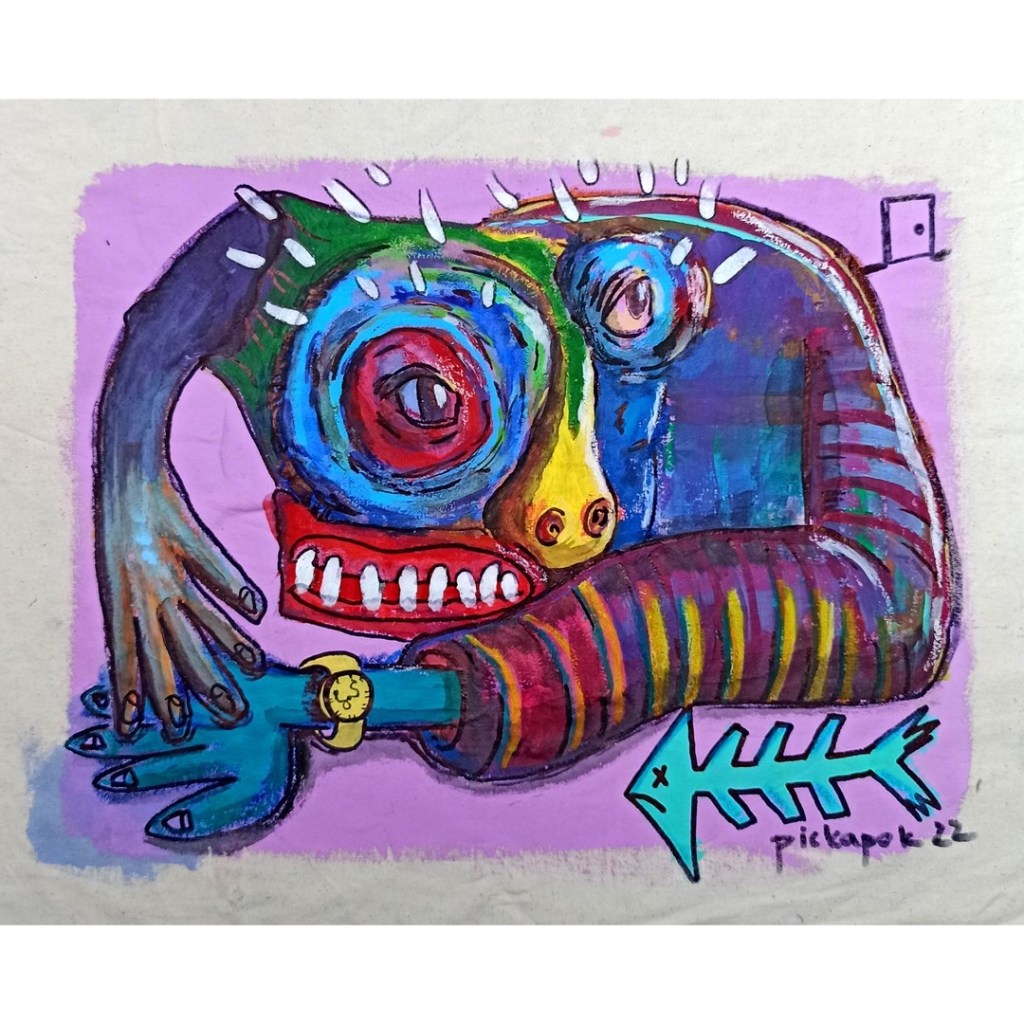
Can you tell us about the origin of the name “Pickapok”?
Pickapok is the art pseudonym I adopted in the second half of 2019. I wasn’t actively searching for an alias, but the name and its visual representation appeared so vividly in my mind that ignoring it was impossible. The image was so clear that it eventually became a logo. The logo features an eye – a symbol already rich in meaning. However, beyond its literal representation, it also conveys a sense of surprise, realization, and awakening. If observed closely, the entire figure can even be interpreted as a reclining person transitioning from one state of consciousness to another.

Looking back, I was experiencing what could be described as a “dark night of the soul”—a period of deep emotional and existential questioning. Pickapok became a companion, serving both as a means of expression and a therapeutic tool.
The works “Shadow Work” and “Blending in” emerged during this period. After all, it was a time of intense reflection on identity, belonging, and the boundaries that affected my state of mind.


You describe yourself as a storyteller. Where do these narratives originate?
The stories in my work do not necessarily belong to me. They are collected, retold, and reshaped, emerging from everyday life—characters, anecdotes, jokes, memories, personal experiences, and social observations. My work examines what it means to be human within a collective experience. These are not merely personal stories; they reflect the masks worn in social spaces, the identities constructed, and the emotions that shape individuals—loneliness, disillusionment, depression, and isolation.
To enhance the visual language, I frequently integrate symbols, signs, and even words in invented alphabets. Occasionally, a single word or phrase becomes central to the narrative. My process combines observation and intuition,
balancing explicit and subconscious elements.
Portraits seem to be a recurring element of your work. What draws you to them?
A figure, person, or portrait is almost always present in my work. The audience engages with the story through their perspective or emotional state. However, identities are not always depicted in a literal sense—some portraits are impressions of people I’ve observed. In certain cases, they remain unknown; only fragments of memory or perception are captured.
Others are based on individuals I know well or personal experiences, yet I often choose to narrate them as if they belong to another. This creates a sense of detachment—a shift in perspective. The characters I depict often appear melancholic, anxious, overthinking, or grotesque in some way. Confusion is a recurring element, but at the same time, these figures feel familiar. After all, the work revolves around human nature.
“waiting for the pizza,” for example, portrays a person worried that the pizza ordered late at night will not arrive. It may sound ridiculous or exaggerated later, but in that moment, the concern feels sincere—after all, hunger is real.

“waiting for the pizza”
“Carrying a house carrying a mountain” came to life during the pandemic, exploring perceptions of responsibility within a home.
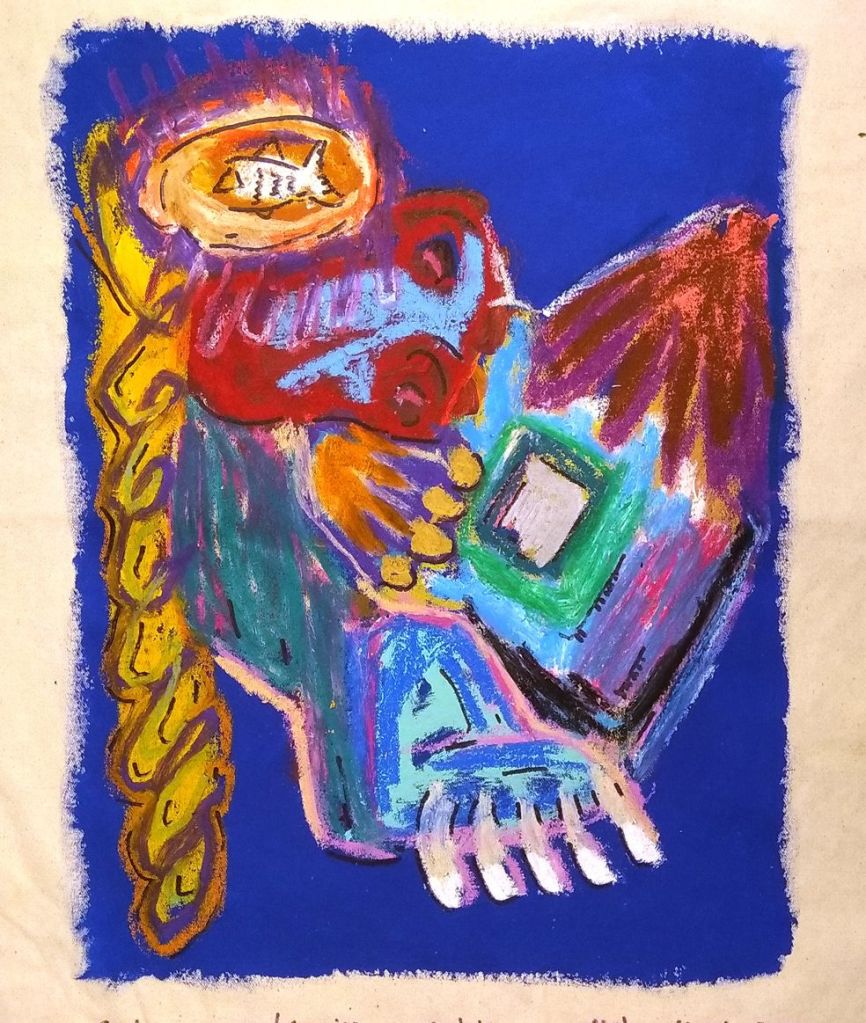
“Tattoo Says Dada, don’t tell it to mama!” The portrait of a person with “DADA” inscribed in a heart on his arm may seem absurd at first glance, but it reflects fanaticism. The fact that this love is hidden from his mother makes the story even more ridiculous and familiar.
You’re transitioning into digital work, but you still create mostly on paper and canvas. What techniques do you prefer?
Although I am currently shifting toward digital, my primary medium remains physical—paper and canvas. My approach is not confined to strict rules or fixed techniques, yet I frequently use acrylic, pastels, markers, ink, and watercolor.
Some pieces also evolve into linocut or screen printing.
How has your creative process evolved over time?
Previously, my creative process followed distinct phases: extensive periods of gathering materials and ideas without producing anything, followed by intense bursts of creation. When I returned to Turkey, this system was disrupted. My practice once integrated found images and objects, yet much of that had to be abandoned. Adjusting took considerable time.
Now, I aim to create daily, always carrying a sketchbook. Whenever something captures my attention, I immediately take note. When inspiration feels distant, these notes become a resource.
Joan Miró once expressed that he felt closer to poets than to painters. Similarly, I resonate with humor. To me, a work should feel effortless, even if refined and reworked multiple times—much like a well-crafted stand-up performance.
Are there influences that have left a strong impact on you?
Rather than fixed influences, I often experience what I’d call a “crush”—a deep fascination with certain elements that linger for a while. However, instead of merely absorbing them, I reinterpret them through my visual language, making
them my own.
In previous works, tarot, astrology, dream symbolism, and Jungian archetypes played a significant role. Many pieces depict portraits as caves, endless staircases leading to unknown destinations, and repeated images of the moon and stars.
At times, a single line from a song or a slip of the tongue remains with me for days. I also enjoy spending time with children and often create in their company. I call them my masters, as their perspective offers invaluable lessons.
How do you approach the beginning and completion of a piece?
A fixed idea or detailed sketch rarely initiates a work. Instead, an impulse sets the process in motion. However, chance and uncertainty remain integral, an influence stemming from Dada. Declaring a work complete or feeling entirely
satisfied with it is challenging.
Stepping away and returning multiple times is common, allowing for new elements to emerge. At times, pieces are even removed from frames and
reworked.
Your work often comes in series rather than standalone pieces. How has this approach shaped your artistic journey?
Working in a series comes naturally. A theme occupying my mind at a given moment, along with the material I’m drawn to, dictates the direction. I often develop multiple pieces simultaneously. Then, that theme may fade only to resurface in a different context, as a missing piece in a new story.
On rare occasions, standalone works emerge that do not fit within any series.
These unexpected pieces, in retrospect, often serve as foreshadowing—like tremors before an earthquake. Over time, they eventually integrate into abroader body of work.

For more information and contact details about the artist: www.pickapok.com


 ArtMeant* Project
Yorum bırakın