“Art is not only a way to express something; sometimes, it becomes a way to survive. What we call a ‘border’ can sometimes just be a new starting point.”
We talked with street artist Atione about his personal life, the experiences he went through in recent years, and the artistic change that happened—a journey of renewal.
Interview by Meryem Özbahar
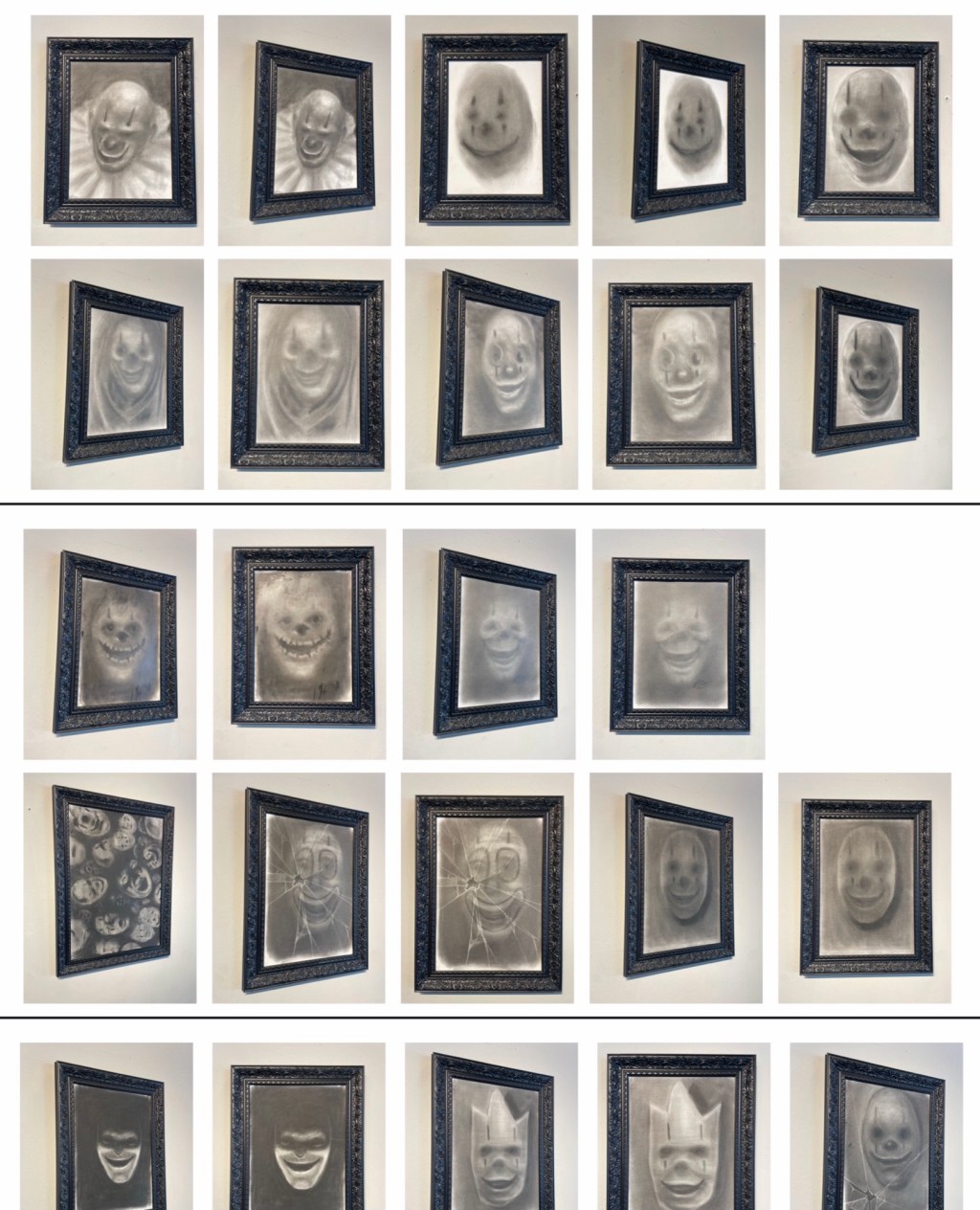
The clown is very important in this exhibition. It shows both happiness and sadness at the same time and represents the contradictions in human nature.What does the clown mean to you? How do you show ideas like masks, roles, and inner conflicts?
For me, the clown is a clear example of opposites. It can look happy on the outside while hiding deep sadness—just like the masks we wear in life. Masks protect us but can also trap us. In this exhibition, I try to show the two sides of the universe and human nature using clowns. Masks are not only for hiding; sometimes, we need them to exist.
How do opposites like good and bad, order and chaos, hope and despair work in art?
Opposites are very important in art. Good and bad, order and chaos, hope and despair are not separate; they define each other. Art shows this tension and helps us understand our own feelings. Clowns, for me, represent this mix—they are both real and fake, both part of a story and the truth. Sometimes, taking off a mask can feel like an even bigger illusion than wearing one.
The “Masks and Identities” section focuses on the tension between social roles and inner identity. Through paintings and installations, you show people trying to discover their true selves. How do you approach the idea of ‘true identity’ behind the masks?
I believe that true identity is not fixed—it is always changing. Often, when people wear a mask, they are showing their natural self. That is why the idea of a “true identity” is a bit of a paradox. If identity is always changing, thinking of it as something unchanging is misleading.
Art does not simply remove masks one by one but shows how they mix together. Behind our masks are many pieces that may contradict each other but also make up a whole. This is why art lets people see not only who they are, but also who they could be.
Your performance on a canvas laid out on the ground first on your knees and then using your wheelchair was very impressive.What did you try to achieve with that performance? What do your body movements, the use of blood and paint, and chance mean to you? How does the performance add to the concept of your art?
First, I am not sure if I should say that I used real blood instead of paint. I wonder what people who fear my clowns would think if they knew. Does this make my performance like a ritual?
More than anything, this performance shows that the body is not just a tool for art—it is art itself. People understand the world not only with their eyes but also with their bodies. Our movements, gestures, and posture all carry meaning. The marks I create by moving my wheelchair and letting blood run on the wheels are like signs made by both our conscious and unconscious actions, not just random events.
Here, blood is not just a material; it is a liquid that carries traces of life. Chance is an artist’s great ally because it goes beyond our control and lets intuition work. This performance adds to my art by showing that art is not only about watching—it is a way of being. The body is an active, creative force in art.
Artists in the graffiti world often use nicknames instead of their real names. What does “Atione” mean to you? How did you build this identity and how has it changed? How does working alone affect your creative process and originality?
For me, “Atione” is not just a signature. It is the way I build my identity and live my existence. Nicknames are not an escape from identity; they recreate it. The name we are given at birth is like a label, but the name we choose is a conscious statement about who we are. “Atione” is the identity I built with my own hands. Sometimes it hurts me, and sometimes it saves me.
Although graffiti often chooses to be invisible, it is one of the most visible forms of art. My individual creative process is shaped by this paradox. Working alone lets me open up to my inner self because when I work on a wall, everything has to be very honest—there is only me and the surface. On the street, time is limited, everything happens fast, and there is little room for mistakes. But these very limitations also define freedom. Working independently creates a constant dialogue within myself. While working in a group shows collective energy, working alone forces me to look deep inside my mind. This loneliness makes me confront my past, fears, and desires. When no one else is around, I must remove my masks and find what I really want to say. Originality comes from this independence—it allows me to follow my inner impulses, create my own rhythm, language, and even chaos without outside influence. Every mistake and chance occurrence belongs to me. I find street art even more courageous than studio work because, on the street, the whole creative process is shared with everyone passing by. Unlike art made in a studio, quickly painted walls—maybe on a whim or even while drunk—are a bold way of expressing oneself.
Your art has mostly been based on graffiti and street art. This exhibition, however, brought you into a gallery space.How do you see this change? How does creating art on the street versus in a gallery affect an artist’s freedom? Are there elements in the exhibition that refer to your graffiti practice?
The street is like art’s natural home. It has its own language and talks directly to society without choosing its audience. That is why graffiti is one of the freest, and at the same time, one of the most ownerless art forms. However, because my illness limits my use of spray paint and similar materials, I had to choose the idea of an exhibition. This was my first personal exhibition and the only one I have done so far. This change made me rethink what freedom means. Freedom is not only about where you work but also about your intention. Making art on the street seems free because it has no rules—but there are rules too, like racing against time, hiding, and being invisible. A gallery, on the other hand, makes you visible but also frames you. I need to do more exhibitions to better see these differences, as I am still new to this. In the exhibition, there are elements that refer to my graffiti practice, such as the use of chance, creating art directly with my body, and the trace left by movement. On the street, your ability to move is everything—climbing high, painting big moments, or sometimes even running away. Since I do not have legs, I had to redefine movement and decided to use a wheelchair. I used to focus on visual reality, but now I think more about abstract reality. This process has made me question life, the universe, and human nature in many ways. Even if it was painful, every loss added new meaning and new pieces to my soul.
Buerger’s disease caused a big change in my life. I noticed that movement—a key part of street art—had to be redefined because of my illness. How did this affect your art and creative methods? Did your physical limits push you to try different creative paths? Do you see your art as a form of resistance? How did having to earn money from your art to get prostheses make you more aware of the connection between art and life?
My illness made me question not only my physical limits but also my mental and artistic boundaries. I started to explore many things through art that I had not noticed before. For me, resistance is not only about opposing something—it is also about rebuilding. At first, I tried to sell t-shirts that I made with stickers, posters, and bleach, but I was not very successful. So I returned to what I do best—what makes me who I am. With few options due to my limited movement and little money, I had to earn money from my art to get my prostheses. I realized that art can be a practical tool for struggle, not just a way to search within myself. This awareness pushed me toward a more physical, experimental, and courageous form of art. Sometimes, art that connects directly with life is the strongest kind of art.
For me, art is not only a way to express myself—it is something that directly meets my life.
What motivates you today, and what are your future plans?
In the future, I want to create art that is not just shown to an audience, but that creates an experience for them. I have ideas about making larger, more physical, and more direct works. The audience should not only be a watcher; they should be drawn into the art and become a part of it. I believe that the art of the future will transform a passive observer into a part of the art itself. The rise of digital art and the impressive examples of performance art from the past and today show this change. I want to continue creating within this transformation.
Two years ago, at the age of 35—what a moment I call “halfway through the road”—I realized that the things that made me who I am were also consuming me. I had to start over without cigarettes, spray paint, walls, or even the street; I had to forget what I knew and rebuild from scratch. I lost my techniques, my painting style, and even the legs that helped me move.
I got divorced, lost my home, ended up with no money, and the worst was being separated from my child. But in that moment, I clung to what hurt me the most: the dream of getting back on my feet, becoming a father to my son, and being an artist who inspires others. In such times, you must hold tightly to your dreams—this is the only way to rise again. I did just that.
I did not accept donations throughout the process. I did this so that when my son grows up, I can leave him a strong legacy as a father—and also to test my own limits. In the midst of all this chaos, trying to sell my paintings to buy my prostheses felt like walking a thin line between madness and courage. I had no other choice, and I came very close to that line. My answer to this question might sound a little sad—I wanted to express my pain honestly and without any filter.
For more information about the artist, visit:
http://www.atione.com.tr


 ArtMeant* Project
Yorum bırakın